Anthropic's IPO debut rests on Google and Broadcom backstops
Anthropic IPO debut leans on Google's backstop of a $19B Kentucky lease and Broadcom's $43B chip-financing support. What each filing says and who is exposed.
Key points
- CNBC's Nov. 15 report says Anthropic's Nasdaq debut, expected Thursday, matters to nearly every major tech company that sells it chips, cloud or money
- Google has agreed to cover rent on Anthropic's 401 MW Kentucky lease if Anthropic defaults, per TeraWulf's Nov. 4 filing
- Broadcom's Oct. 26 filing caps its chip-financing backstop at about $43 billion, which we calculate is 68% of the $63 billion financing structure
- Anthropic's own S-1/A counts about $900.9 billion in contractual obligations and says it has underestimated compute needs before
- Deliveries behind these backstops start in late 2027, so the guarantees are mostly untested
Anthropic's stock hasn't traded yet, and at least two of the companies around it are already on the hook if it stumbles. Google has agreed to pay rent on a Kentucky data center if Anthropic can't. Broadcom has put up residual-value support worth up to about $43 billion behind a $63 billion chip-leasing deal. The Anthropic IPO, which CNBC says is expected to debut on the Nasdaq on Thursday, Nov. 19, is the first time the public gets to price that web of promises.
CNBC's Nov. 15 report calls the offering "the most important tech IPO in years," arriving after a month the network describes as rough for the sector. We went to the filings behind its numbers: the amended S-1, TeraWulf's Nov. 4 8-K and Broadcom's Oct. 26 8-K.
CNBC's post on X, Nov. 15, 2026, on Anthropic's IPO and the AI trade (@CNBC)
A $900 billion bill with a ticker attached
The S-1/A, filed to list Class A shares on the Nasdaq Global Select Market under the symbol ANT, puts Anthropic's contractual obligations at about $900.9 billion, "substantially all" of it compute and infrastructure. One line item stands out: in April 2026 Anthropic committed to spend at least $110.0 billion with Amazon between May 2026 and April 2036, "regardless of actual usage," with a true-up payment if it falls short.
"The numbers are just staggering. It's hard to get your head wrapped around it." — Joe Fath, partner at Eclipse and former T. Rowe Price portfolio manager, to CNBC, Nov. 15, 2026
The prospectus also admits the opposite risk. "In the past, we have significantly underestimated our compute requirements," it says, which "left us capacity constrained." That sentence goes some way to explaining why a company still booking losses signs 10-year and 20-year contracts.
The Kentucky lease Google would take over
TeraWulf's 8-K describes a 20-year lease, signed in July, for about 401 MW of IT load at a campus in Hawesville, Kentucky. On Nov. 4 it added three credit-support agreements with Google. If Anthropic misses a payment or becomes insolvent, Google can pay the rent due and take over the lease as tenant, or pay a termination fee and receive an equity interest in the TeraWulf subsidiary that owns the campus.
The backstop switches on only when the final data hall of each lease begins paying rent. Delivery runs in phases from late 2027 to the second quarter of 2028. It ends if Anthropic holds certain investment-grade credit ratings for at least three months. CNBC cites TeraWulf for the $19 billion lease figure and says Google will own about 13% of Anthropic after the IPO.
That ownership stake is why the backstop isn't pure charity. Google is guarding a tenant it already holds a slice of, and it plans to sell that tenant chips: the S-1/A says Anthropic expects to spend $125.0 billion to $150.0 billion on Google AI chips, a figure CNBC notes won't start delivering until 2028.
How Broadcom's promise is built
Broadcom's own release, issued with Bank of America, Blackstone, Citi and Morgan Stanley on Oct. 26, describes a $63 billion transaction run through a new special purpose vehicle. The vehicle buys Broadcom-designed accelerators and networking gear and leases them to Anthropic, with deliveries starting in 2027. The three banks arrange the first-lien debt; Blackstone alone commits the second-lien piece.
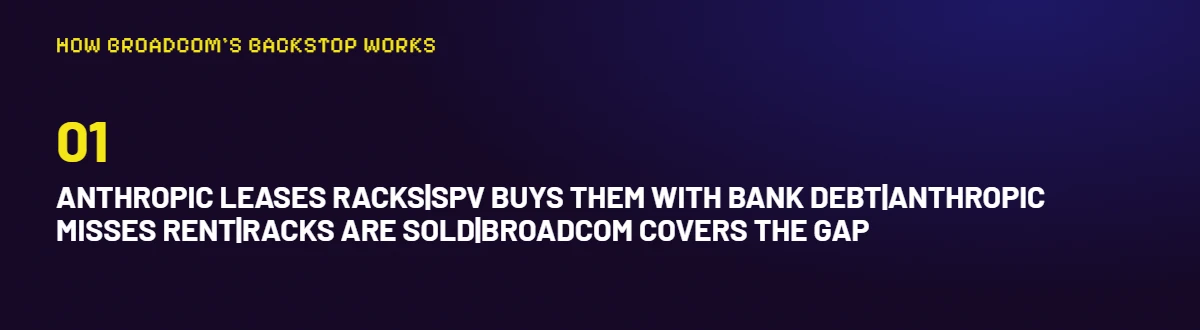
The 8-K gives the mechanics. If Anthropic defaults, Broadcom's liability equals any shortfall between 72.5% of the outstanding lease amounts and what the racks fetch when sold, and its maximum, on an undiscounted basis once all racks are deployed, is "approximately $43 billion." The exposure grows as racks are delivered and shrinks as Anthropic pays. Broadcom calls the scenario a "low probability" event.
Our math: $43 billion against the $63 billion structure is 68%, so Broadcom stands behind roughly two of every three dollars. The company's release says the support matches the first-lien amount, which lines up with that ratio. CNBC reports the same split between the $63 billion offered by the banks and Blackstone and the $43 billion Broadcom backstop.
A debut with several other deadlines
CNBC places the IPO inside a bad stretch: the Nasdaq fell 5.3% in October, its worst month since March 2025, and Nvidia shares dropped 13% this week after CEO Jensen Huang's ouster. Interim chief Colette Kress reports quarterly results on Tuesday, two days before Anthropic trades. We covered the leadership change in our report on Huang's resignation and the Reuters finding on Chinese projects.
The same week also decides whether the supplier money lands. Seven companies, among them Google, Nvidia and Broadcom, will put $26.0 billion into Anthropic's stock when the offering closes. Add the backstops and these companies are Anthropic's vendors, shareholders and, in two cases, its guarantors at once. CNBC's expert sources split on whether that is prudence or exposure; David Tollen of Sycamore Legal called it "smart investing" because the companies are "investing, in a sense, in themselves."
What the numbers leave open
The expected pricing band of $70-$78 is still an estimate. At the midpoint, the S-1/A puts net proceeds from the offering and the private placement at about $84.6 billion; CNBC says the raise could top $90 billion in gross proceeds, on top of $131.8 billion in cash and short-term investments at Sept. 30. The $900.9 billion in obligations, by contrast, is spread over a decade or more.
What isn't known: how much of the Broadcom backstop is drawn on in a mild downturn rather than a default, and whether Google's agreement covers every Anthropic site or only the Kentucky campus. TeraWulf's filing speaks only to the leases it signed.
Pricing is the next date to watch, expected Nov. 18 in our earlier reporting, with Nvidia's Tuesday report landing just before it. If the shares open weak, the first tests of these guarantees won't be legal. They'll be in how the market prices the companies holding them.
Source: CNBC
Latest
- 01AMD's Lisa Su is named CEO of the Year as Nvidia's CEO walks outBusiness · 2026-11-13
- 02Jensen Huang resigns as Nvidia CEO, Colette Kress named interimBusiness · 2026-11-13
- 03ChatGPT Finances comes to the desktop app for users in the USProducts · 2026-11-12
- 04Nvidia board prepares to oust CEO Jensen Huang, WSJ reportsBusiness · 2026-11-12
- 05Anthropic's suppliers will buy $26B of its stock at IPO priceBusiness · 2026-11-11