Jensen Huang resigns as Nvidia CEO, Colette Kress named interim
Jensen Huang resigns as Nvidia CEO and CFO Colette Kress steps in. A day later, Reuters tallied $3.2 billion in China projects built on its chips.
Key points
- Jensen Huang resigned as Nvidia's president, CEO and board member effective immediately; the board accepted it on Nov. 11 and Nvidia announced it Nov. 12
- CFO Colette Kress is interim CEO and stays CFO; Harvey C. Jones, a director since 1993, becomes the board's first chair
- Neither the press release nor the 8-K filing gives a reason, a severance figure or a search timeline
- On Nov. 13 a Reuters review counted about 23 billion yuan ($3.2 billion) in Chinese computing projects built around restricted Nvidia chips such as the H100, H200 and H800
- Reuters says those projects aren't linked to Megaspeed or the allegations about Huang, and no public finding says Huang broke export laws
Jensen Huang resigns from the company he co-founded in 1993 and ran for 33 years. Nvidia's board "accepted the resignation of Jen-Hsun Huang" as president, CEO and director, effective immediately, according to the Form 8-K Nvidia filed with the SEC. Chief financial officer Colette Kress is now interim CEO while directors look for a permanent one.
The filing dates the decision to Nov. 11, the same evening the Journal said directors were getting ready to remove him, which we covered as it broke. Nvidia's announcement followed on Nov. 12. Neither document says why he left.
Two documents, no reason
The release is short. Kress, 59, has been CFO since 2013 and keeps that job too. Harvey C. Jones, 73, a director since 1993 and a former Synopsys CEO, becomes the board's first-ever chair, a seat Nvidia never had while Huang ran it. The search will look at internal and external candidates, and there's no deadline.
"The Board has full confidence in Colette and the leadership team." (Harvey C. Jones, Nvidia chair)
What's missing matters as much. The 8-K lists no severance, no equity terms, no interim pay for Kress and no statement about any disagreement. Huang isn't quoted in the release at all. His last public words on the matter are still the staff letter of Nov. 8, where he wrote that he "was unfaithful" to his wife.
CNBC, citing a person familiar with the decision, reported that directors turned against him after a second relationship surfaced, this one with an Nvidia executive, on top of the earlier reports about Alice Huang, the former Megaspeed executive U.S. officials reportedly suspect of working for Chinese intelligence. That's the account behind the exit. The company hasn't confirmed it.
The $3.2 billion Reuters found the next morning
A day after the resignation, Reuters published an exclusive with a number that cuts against what Nvidia has told investors for over a year.
Reuters' Nov. 13 post on its China projects review (@Reuters)
Reuters posted it on X at 4:25 a.m. ET on Nov. 13. Its point: Nvidia says U.S. export controls have "effectively shut it out" of China's AI data-center market, yet its review identified more than $3 billion in Chinese computing projects built around the company's restricted processors.
The method is what makes it hard to wave away. Reuters reporter Eduardo Baptista and his colleagues went through more than 150 Chinese procurement notices, investment plans, construction contracts and corporate disclosures. The projects named H100, H200 and H800 chips and added up to roughly 23 billion yuan, about $3.2 billion. They run from coastal tech hubs to western provinces and include local-government ventures, universities and regional computing centers, not just the big platforms. One retrofitted commercial site in Gansu province was expected to install thousands of Nvidia chips before year-end; Reuters couldn't tell whether they arrived.
Two limits are spelled out in the story itself. The total includes buildings, power systems and planned spending, so it isn't $3.2 billion of chips. And the documents don't show how the hardware reached China. Reuters also says these projects aren't tied to Megaspeed or to the allegations about Huang. Nvidia and China's commerce ministry didn't respond to its questions.
Our reading: the Reuters figure isn't Nvidia revenue. It measures how much Chinese infrastructure was planned or built around hardware Washington restricts, and that is exactly the exposure lawmakers are now asking about.
Where 'zero' meets 34%
Huang said last year that Nvidia's China share had fallen from 95% to zero, and the company leaves China data-center revenue out of its forecasts. Reuters set that against an IDC estimate it cited in October: Nvidia still accounted for 34% of Chinese AI-accelerator shipments in the first half of 2026. The two numbers measure different things, as Reuters notes, but they don't sit comfortably together.
Sunny Cheung, an analyst at the Jamestown Foundation, told Reuters that "Washington must stop focusing solely on who buys the chips on the surface" and look at who ends up using the computing power.
We think this is the report Huang would have been asked to answer. With him gone, the questions land on an interim CEO who is also the CFO, which is the person who signs the numbers.
Washington moves on three fronts
The Justice Department is now part of the story. Semafor reported multiple inquiries that could draw in Nvidia, including an antitrust probe of the company and separate matters involving Megaspeed and Super Micro, according to Investing.com's write-up. Bloomberg reported that Manhattan prosecutors are examining whether entities linked to Alice Huang helped move Super Micro servers into China. Super Micro says it's cooperating, Megaspeed denies wrongdoing, and nothing so far indicates charges against Nvidia or Huang.
Congress hasn't let the resignation end it. In CNBC's live coverage, House Foreign Affairs Chair Brian Mast said Huang agreed to testify before Thanksgiving, date still under negotiation, and Sen. Tim Scott asked him to appear before the Senate Banking Committee on Dec. 3, with Commerce Secretary Howard Lutnick on Dec. 10. That's a step up from the closed-door request three House chairs sent on Nov. 4. Sen. Elizabeth Warren said the resignation doesn't absolve Huang or the company.
President Trump called it "a horrible thing" in an interview, CNBC reported, and suggested on Truth Social that Apple's Tim Cook should take the job.
The bill on Wall Street
Shares fell more than 13% at Thursday's open, pushing Nvidia below $4 trillion in market value, then closed down 4.3%, per CNBC. From Wednesday's $173.73 close, that works out to about $166, our math, roughly 30% under the $239.24 closing high of Oct. 6.
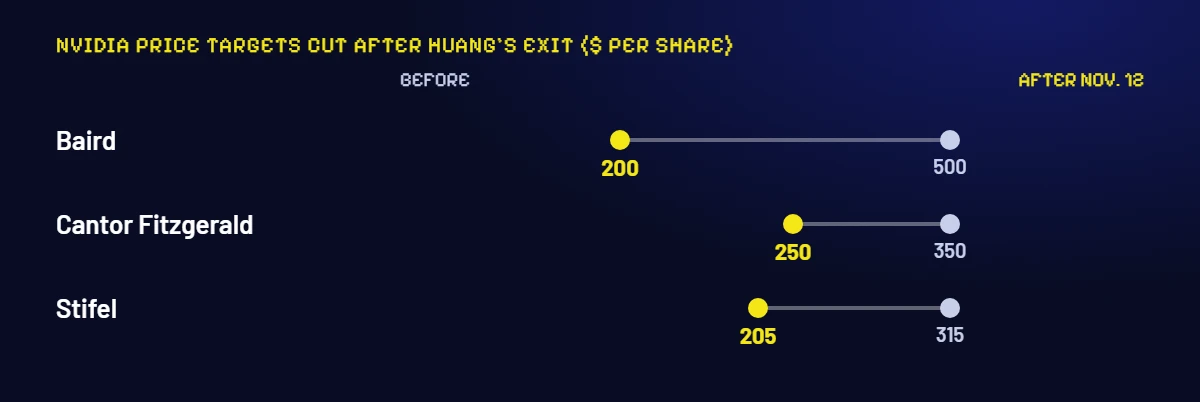
Analysts rewrote their targets. Baird downgraded to neutral and cut to $200 from $500, a 60% reduction by our count; Stifel went to $205 from $315 and Cantor Fitzgerald to $250 from $350 while keeping its overweight rating. Cantor's CJ Muse called Huang being forced out "a major loss for Nvidia and also a major loss for the United States." Janus Henderson's Jeremiah Buckley described it as a possible "clearing event."
The selling spread. CNBC reported Nebius down 17% and CoreWeave about 12%, while AMD gained 3% on Thursday. In China, AI stocks slid on fears of tighter access, and one underground chip trader said deals were on hold into next week. The same report put the gray-market price of eight B300 GPUs at 20 million yuan ($2.99 million), about 5.4 times the $550,000 official U.S. price.
Tuesday's call is Kress's first test
Nvidia reports third-quarter fiscal 2027 results on Tuesday, Nov. 17, with the call at 2 p.m. PT, and Jones said operations, customer commitments and the product roadmap should continue "without interruption." That call now has three questions it can't dodge: who runs the company next, what the board's investigation has found, and how much of China's buildout still runs on Nvidia silicon. Will Kress put a number on China, or repeat that the market is zero?
Latest
- 01Anthropic's IPO debut rests on Google and Broadcom backstopsBusiness · 2026-11-15
- 02AMD's Lisa Su is named CEO of the Year as Nvidia's CEO walks outBusiness · 2026-11-13
- 03ChatGPT Finances comes to the desktop app for users in the USProducts · 2026-11-12
- 04Nvidia board prepares to oust CEO Jensen Huang, WSJ reportsBusiness · 2026-11-12
- 05Anthropic's suppliers will buy $26B of its stock at IPO priceBusiness · 2026-11-11