Google Suncatcher Gemma 4 Orbit Test: What the Haiku Proves
Google's Suncatcher satellite ran Gemma 4 on a TPU in orbit. One prompt, one of four chips on at a time: what the haiku proves and what is still untested.
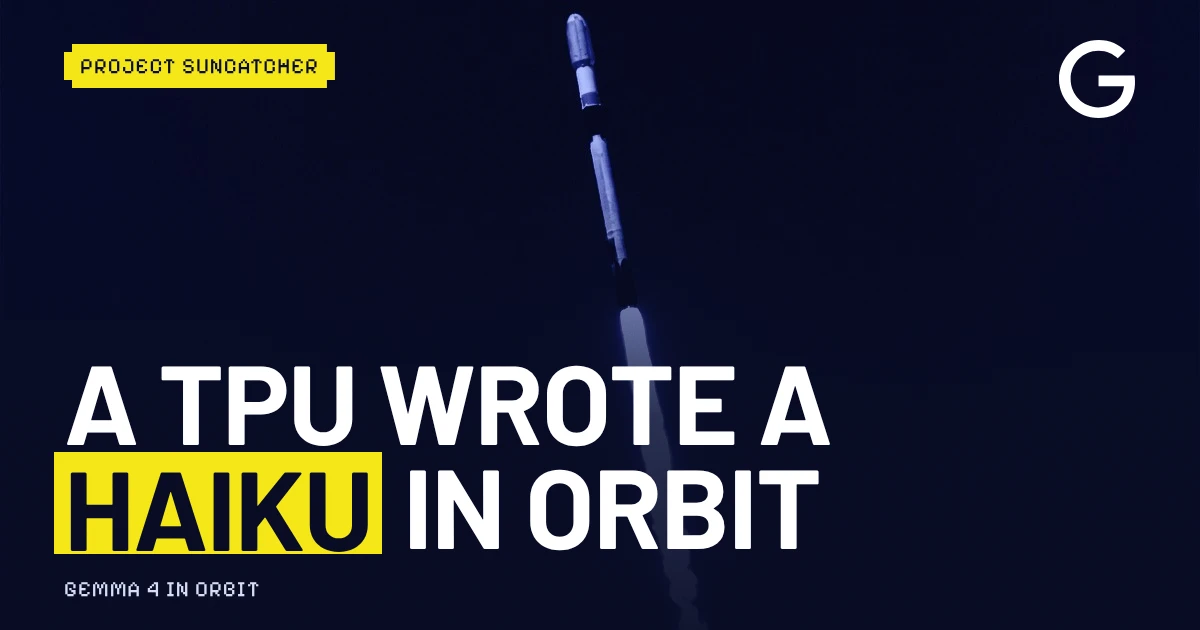
Google Suncatcher sent three lines of poetry down from low Earth orbit over Svalbard, Norway, and Google called it a milestone: "the first-ever AI response from a data center class TPU in orbit." The model was Gemma 4, the chip was a Tensor Processing Unit on the Project Suncatcher prototype satellite, and the prompt was a request for a haiku.
It's a charming result and a real one. It's also one prompt, so it helps to be exact about what it settles.
Google Gemma's post on X, Nov. 3, 2026, about running Gemma 4 on the Suncatcher satellite (@googlegemma)
The post from @googlegemma, dated Nov. 3, opens with "Gemma 4 in Space" and says Project Suncatcher "just booted up data-center TPUs aboard a prototype satellite and ran Gemma 4 in Low Earth Orbit." It's a replay, not new news. The announcement itself is Google's blog post by Travis Beals, dated Oct. 30, four days earlier, and that's the document we read for everything below.
What Google actually reports
The post says that after launch on Oct. 1, the team spent "the last few weeks completing our commissioning checklist, which included powering up the host and TPU trays and successfully running early machine learning tests." Then came the haiku, uplinked during a ground-station pass and downlinked as the satellite passed Svalbard:
Blue marble below / Data streams in silent grace / Starlight feeds my core.
Afterward the team "tested space-themed limericks and telemetry prompts reporting the technical status of the payload systems." That's the whole list of workloads. Google's post gives no latency, no throughput, no power draw and no model size. It doesn't say which Gemma 4 variant flew or which TPU generation is on board.
One chip at a time, 20 minutes at a time
The hardware details come from TechCrunch's Oct. 30 report, not from Google's post. According to TechCrunch, the satellite carries four TPUs and generates up to 1 kW of electricity, and because of that limit it can run only one TPU, for about 20 minutes at a time. At launch, TechCrunch had reported 15-minute bursts, so the window looks to have moved.
Our reading: "data center class" describes the chip, not the setup. A single accelerator on a duty cycle shorter than a TV episode, with a power budget around that of a space heater, is a lab bench in orbit. That's what a first test should be. It also means nothing in this result speaks to the thing Suncatcher is ultimately about, which is many TPUs working in parallel over fast links.
The radiation numbers were measured on the ground
Whether a TPU survives space is the question the satellite exists to answer, and the haiku doesn't answer it. Google says the next step is a series of tests "to evaluate how TPUs perform under thermal stress and radiation exposure in orbit."
The only radiation data so far comes from proton-beam tests on Earth, reported in Google's preprint paper (we read the arXiv v2). In those tests, high-bandwidth memory showed irregularities after 2 krad(Si), almost 3× the 750 rad(Si) minimum Google set for a five-year mission, while end-to-end ML workloads kept running to the maximum 15 krad(Si) tested. The sharper number is about silent data corruption: roughly one event per 17 rad. At an estimated 150 rad(Si) per year in orbit, the paper puts that at about "1 per 3 million inferences, assuming 1 inference per second," and calls it "likely acceptable for inference" but not settled for training.
Here's our arithmetic, built on the paper's rate and nothing else. A 20-minute window at one inference per second is 1,200 inferences, so 3 million inferences is roughly 2,500 windows. That's comfortable, if the ground figure holds in orbit.
And here's why a haiku can't test it. A silent bit flip in a poem produces a slightly different poem. Nobody can tell a corrupted haiku from a fresh one, because there's no right answer to compare against. Telemetry prompts are closer to a check, since the readings can be compared with the satellite's actual sensor data, but Google hasn't published that comparison.
Quick answers
Is this a new Gemma release? No. Google's post describes running its existing Gemma 4 open model on the satellite.
Can developers use TPUs in orbit? Nothing in Google's post mentions access, an API or pricing.
What did the haiku cost? The Register estimated the roughly 20 output tokens at about $0.000012 at Gemma 4 26B's cloud price, set against a satellite it guessed at 500 kg. Those are the outlet's assumptions, not Google's figures.
Which Gemma 4 model flew? Unconfirmed. The Register priced the 26B model, but Google's post doesn't say.
The number that would settle it
Google's 2027 milestone is "twin interconnected satellites" with laser links, and TechCrunch reports they will carry more power. Before that, the team has promised radiation and thermal results from this one. When they land, skip the narrative and look for a count: corrupted outputs per TPU-hour in orbit, set beside the ground-test rate of one silent error per 17 rad. If those two numbers agree, the haiku was the easy part and the moonshot just got a lot more believable.
Latest
- 01Vercel Security Review: What a Per-Push Scan Covers and CostsProducts · 2026-11-04
- 02FlashProve: What Anthropic's Provable Inference Speed MeasuresWorld · 2026-11-03
- 03uni-robot-agent: What Qwen3.8-Flash-Next's 31.39 Really BeatsModels · 2026-11-03
- 04LlamaIndex OCRia-1 Inference: What the 10x Speedup MeasuresModels · 2026-11-03
- 05Xiaomi-OCR-0: Why a 95.24 Real5 Score Became 92.73Models · 2026-11-03