uni-robot-agent: What Qwen3.8-Flash-Next's 31.39 Really Beats
Qwen3.8-Flash-Next tops GPT-6 Astra on RoboDojo, 31.39 to 28.97, but only against Astra's baseline harness. On the same harness, Astra scores 51.90.
"Can Qwen directly control the robot as well as GPT-6 Astra?" That's the question on the new uni-robot-agent post, and the paper's answer is a number: 31.39 for Qwen3.8-Flash-Next against 28.97 for Astra on the RoboDojo simulation benchmark. The number is real. What it beats is narrower than the post suggests.
Yuxin Zuo's post on X, Nov. 3, 2026, introducing uni-robot-agent and its benchmark chart (@zuo_yuxin)
The post from @zuo_yuxin, dated Nov. 3, says: "Introducing uni-robot-agent: a unified harness for Robot-Use Agents (RUAs), a first step toward RUA training and local deployment." Thirty-five minutes later, @QwenDevs quoted it: "turns out Qwen3.8-Flash-Next can do more than work with software tools, it can operate real robots too." We read the paper (arXiv v1, Nov. 1), the project's GitHub repository and its README. Both posts are long and show only their first lines in the copy we could read, so everything below rests on those documents.
Qwen Developers' post on X, Nov. 3, 2026, quoting the uni-robot-agent announcement (@QwenDevs)
The same model scores 1.90, then 31.39
A "harness" is the scaffolding around a model: the tools it can call, the feedback it sees, and how its commands reach the robot. Here, it matters more than the model.
In the paper's Table 1, Qwen3.8-Flash-Next scores 1.90 on RoboDojo with the RoboProbe harness, the one used for the published Astra number. With uni-robot-agent and no depth data, the same model scores 31.39. That's the +29.49 points shown on the chart.
GPT-6 Astra tells the same story. Its published 28.97 comes from RoboProbe. Put it in uni-robot-agent and it scores 51.90, according to the paper.
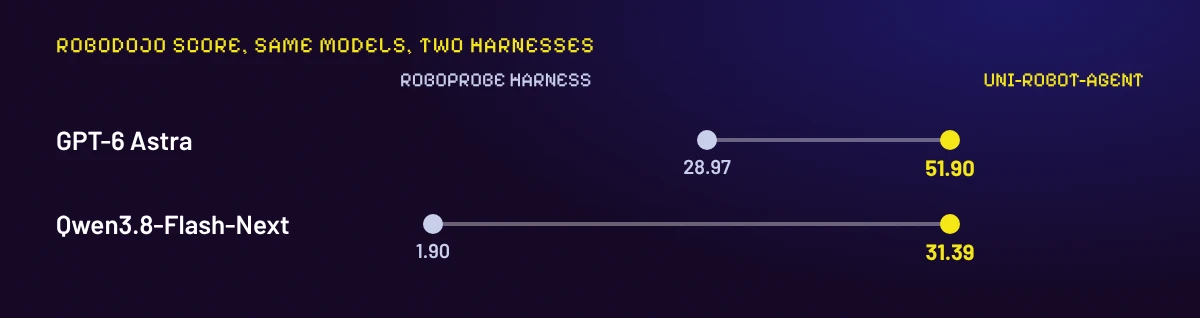
Read across and the post's headline comparison, 31.39 against 28.97, sits on a diagonal: Qwen's right-hand dot against Astra's left-hand one, a new harness against an old one. On equal footing, Astra leads by 20.51 points (our subtraction). The paper says as much: "GPT-6 Astra equipped with uni-robot-agent performs the best."
What the cheaper model buys
The paper does make a fair case for Qwen, and it's about money. It reports $1.09 per episode for Qwen and $21.29 for Astra, "nearly 20x more," the 19.52× figure on the chart. By our arithmetic, Qwen reaches about 60% of Astra's score (31.39 of 51.90) at about 5% of its cost.
Two caveats from the paper's own methods. Qwen's results average three seeds and two layouts per task, while the paper says its Astra input-settings tests used one seed and one layout per task "due to limited evaluation costs." And the paper's first-of-its-kind claim, that this is "the first system to outperform closed-weight foundation models on RoboDojo using open-weight models," is the authors' own, with no outside check.
Real robots: 49.50, 53.50, or neither?
The shared chart shows a real-world panel: Qwen with uni-robot-agent at 53.50, fine-tuned Pi0.5 at 47.75 and Dream-1 at 43.50. The paper's Table 2 says something different: Qwen 49.50, Pi0.5 47.75, Dream-1 35.50. We added up the per-task scores in Table 4 and they match the paper (49.50 and 35.50). The chart's 53.50 and 43.50 appear in neither version we could open, and we couldn't find which is current. Unconfirmed.
Either way, the gap to Pi0.5 is small, and the setup tilts. The paper says its agents "additionally receive depth" from RealSense cameras, while Pi0.5 and Dream-1 use RGB only, and Pi0.5 was fine-tuned on 10 hours of demonstrations per task. The benchmark is the authors' own, with 19 tasks. Astra on the same real robots scores 75.50.
What you can run today
The code is MIT-licensed. It installs from PyPI (pip install uni-robot-agent), expects a Linux GPU host with Python 3.11, and runs on Codex and Claude Code runtimes. You supply a model through a Responses-compatible endpoint. The simulators in the release are RoboDojo, RoboUse and RoboLab.
The paper's author block lists Tsinghua University and UC Berkeley, not Alibaba. The "Qwen developers" framing comes from the @QwenDevs post, and we haven't verified any company affiliation.
The sentence in the README to read first
Under "Real robots," the README lists ARX One and Franka as "Coming soon," and then says: "The public package does not yet include a supported physical-robot connection workflow." So the claim that Qwen "can operate real robots" is, today, a result in a paper, not something you can reproduce from the repository.
Source: arXiv:2611.01560, Democratizing Robot-Use Agents: A Unified Harness with Open Models
Latest
- 01Vercel Security Review: What a Per-Push Scan Covers and CostsProducts · 2026-11-04
- 02FlashProve: What Anthropic's Provable Inference Speed MeasuresWorld · 2026-11-03
- 03LlamaIndex OCRia-1 Inference: What the 10x Speedup MeasuresModels · 2026-11-03
- 04Google Suncatcher Gemma 4 Orbit Test: What the Haiku ProvesModels · 2026-11-03
- 05Xiaomi-OCR-0: Why a 95.24 Real5 Score Became 92.73Models · 2026-11-03