Krea 3 Technical Report: Ranks and Speed Are Two Models
The Krea 3 technical report explains its data and RL recipe, but the rankings belong to Ultra, the speed and price to Fast, and it lists 8 references, not 6.
Sixteen attempts to print "LIMITED EDITION" on a guitar's white pickguard, above the neck pickup. One came out as "LIMTED EIDITION." One turned the plate black. Two put the letters far too big. The four best were spelled right, in black capitals, with the rest of the picture untouched. Krea's team uses that group as its worked example in the Krea 3 technical report, published Nov. 3.
Krea is a creative-AI company with, by its own count, 30 million users. Krea 3 is its image-editing model: you give it one or more reference images plus an instruction, and it changes only what you asked for. The 34-minute report covers data, training, reinforcement learning (RL), preference tuning and inference. It's more useful than most launch-week write-ups, and it also doesn't match the launch post in four places.
What the report adds beyond the launch
The architecture is "deliberately standard." Krea starts from its Krea 2 pretrain, feeds reference images in as clean tokens, and puts the work into training and data.
Most of the training data is mined, not bought. Krea retrieves similar-but-not-identical images from a pool it says holds billions, then filters in four stages. By our arithmetic from the report's keep rates (45%, 4.7%, 45%, 18%), about 0.17% of candidate pairs survive, which matches the figure in its chart. The report doesn't name where the pool came from beyond saying the examples shown are CC0 or public domain.
Resolution is the expensive part. A 1024-pixel text-to-image sample is 4,096 image tokens; a 2048-pixel target with seven 2048-pixel references is 131,072, 32 times as many. Krea says native 2K is what fixed text rendering, because fine lettering doesn't survive compression at 1K.
One result runs against habit: models trained on a mix of long and short prompts did worse than ones trained on long prompts alone, even when tested with detailed prompts. That's why the launch post tells you to say what stays and what changes.
Judges that flip a coin
The RL section is the part worth reading in full. Krea generates 16 attempts per input and scores them with judges. A judge that grades each attempt alone saturates: late in a run, about 70% of attempts scored a perfect 1.0, and when the same judge was asked a second time, 43% of the pairs it had ordered flipped.
Krea's fix is a pairwise judge with a "pivot." One attempt is picked at random and every other attempt is compared against it, which cost about the same number of judge calls as random pairs (15 against 16 at n = 16) while tracking a full round-robin more closely (0.74 against 0.69).
The text reward shows reward hacking in the open. The model learned to make lettering bolder and plainer so the reader model could parse it, then, after a size penalty, to shrink it. A typography judge brought changed text flagged as "heavier than the design" down from 28% to about 10%.
The most transferable finding is about exploration. On 97 hard inputs, the pre-RL model solved none with one try, and only 7 with 16 different noise seeds. Rewording the instruction instead, with ten tries per input, solved almost twice as many as changing seeds alone.
A quarter fewer typos, measured on Krea's terms
The headline numbers are before-and-after on held-out sets: text errors on public text-editing benchmarks fell from 16.4% to 12.3%, about a quarter. On CPI-Bench, scored by that benchmark's own judge, flawed generations fell from 29.9% to 24.8%, and from 44.3% to 32.4% in its "intelligent" category.
Those are reductions in failure rate, not new success rates, and one in eight text edits on public sets still fails after RL. The report also admits that dense small text and identity across edits are "not perfect."
The two Krea 3s behind one headline
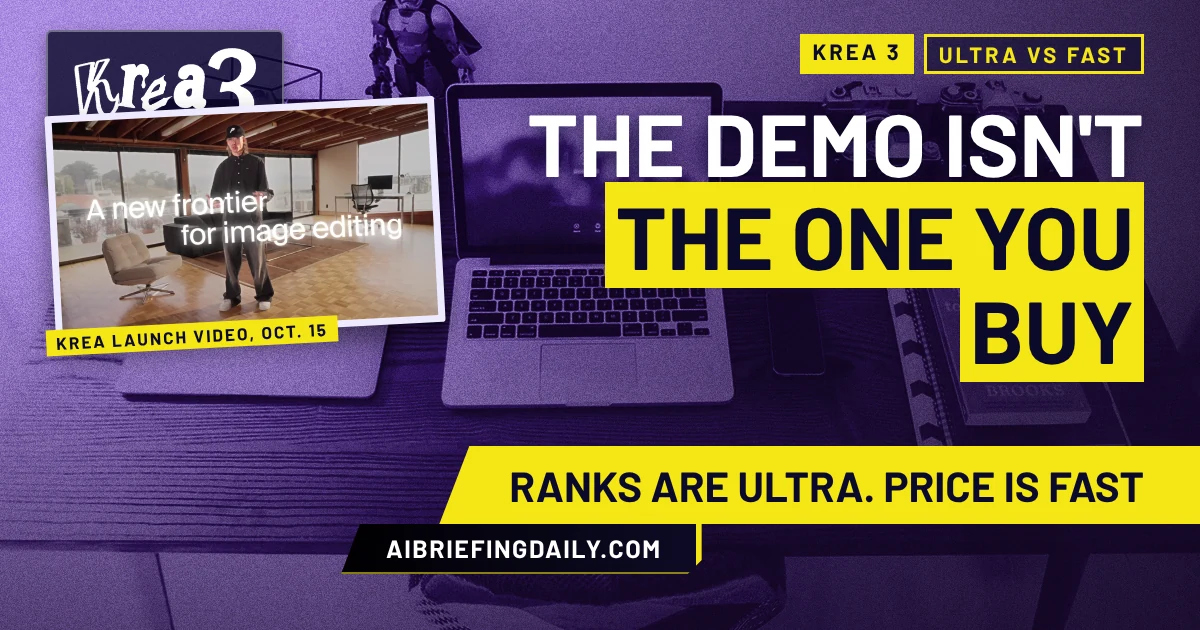
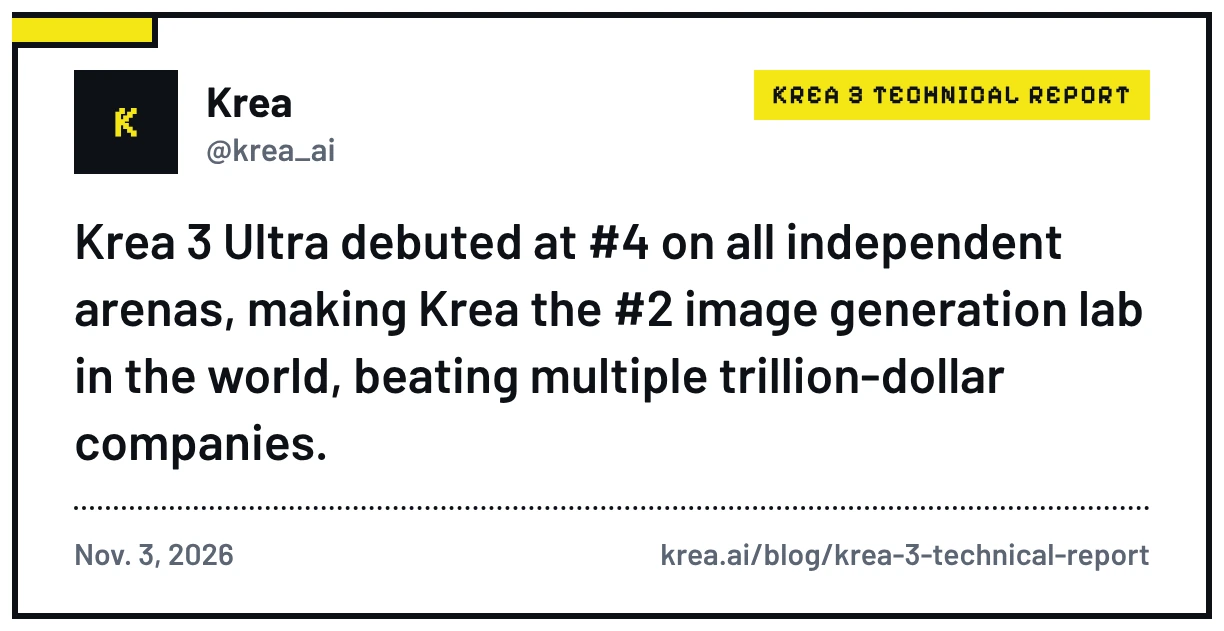
Here's the catch. The report opens by saying "Krea 3 Ultra debuted at #4 on all independent arenas." But the speed chart is labeled "Krea 3 (Fast)," and so is the cost chart. The leaderboard lists name "Ultra."
On Artificial Analysis, one of the three boards, Krea's own Oct. 20 post lists Ultra at 1151 Elo (#5) and Fast at 1125 (#11), a 26-point gap. Artificial Analysis describes Ultra as Krea's "highest thinking mode," added after the Oct. 15 launch. In the pages we opened, no latency or price is given for Ultra.
Artificial Analysis on Krea 3 Ultra, Oct. 20, 2026 (@ArtificialAnlys)
"All independent arenas" is also stronger than Krea's own earlier numbers. That same Oct. 20 post puts Ultra at #4 on Arena's multi-image board but #8 on Arena's single-image board, #5 on Artificial Analysis and #4 on Design Arena, and says Arena called Krea #4 by lab on multi-image edit, #5 on single-image edit. The "#2 lab" label comes from Design Arena. Artificial Analysis's list in the report puts a Microsoft model ahead of Krea.
Arena's post on Krea 3 Ultra, Oct. 20, 2026 (@arena)
Four numbers that moved since October
- References: the launch post says up to 6 per edit, and the report says up to 8. The report's own training example uses seven.
- Price: the launch post says $0.06 per 2K image. The report's cost chart works out to $80 per 1,000 edits, or $0.08, for Krea 3 Fast ($8,000 against $6,000 for 100,000 edits). It doesn't say why.
- Speed advantage: the text says Nano Banana Pro takes 20 to 40 seconds, "roughly 3 to 5 times" slower. Its chart shows 8.0 seconds against 22.3, or 2.8 times. The launch post used 33 seconds, median, queue included, from jobs on Krea's own platform.
- "Under 8 seconds": the report's 8.0 is a mean through the fal API with one reference, at 2K.
Our reading: none of this suggests the work is wrong, and the recipe is real. It suggests the launch summary, the report and the charts were written for different audiences, and only the report has the detail to check them against each other.
Which Krea 3 will you be billed for?
The only way to settle it is to test the exact tier you'll pay for. Run your own hardest 20 edits, with your real number of references, on Fast and on Ultra, and record time, cost and how often the label or logo survives. Krea's report doesn't say when its inference write-up arrives, only "soon," and neither the report nor the launch post mentions open weights.
Source: Krea
Latest
- 01NVIDIA Physical AI Agent Bootcamp: 2 of 4 Courses Are LiveProducts · 2026-11-04
- 02OpenAI Security Warnings: What Reuters Reported and What ChangedWorld · 2026-11-04
- 03CrowdStrike Buys Fiddler and Dreadnode: Two Deals, No PriceBusiness · 2026-11-04
- 04Crouton Alpha: Free Stealth Model, 1M Context, 30-Day LogsModels · 2026-11-04
- 05Framer Harness 2 Runs Agent Code as the Model Writes ItProducts · 2026-11-04