Anthropic's IPO Sells Shares, Not Control: 50.1% Stays Put
Anthropic's IPO roadshow offers 825M shares, but one Class F share holds 50.1% of the votes and 5.66B Class N shares have none. What buyers actually get.
Anthropic's IPO sells shares, not control: anyone who buys the stock when it lists will own part of the company's profits and almost none of its decisions. The company launched its roadshow on Nov. 10, 2026, offering 825 million Class A shares, and the amended filing behind it explains why the vote stays where it is.
Anthropic's post on X, Nov. 10, 2026, announcing the roadshow (@AnthropicAI)
Anthropic's post on X went up at 6:33 a.m. Eastern. It says the company "has launched the roadshow for its proposed initial public offering" and points to the press release, which gives the structure: 801,351,354 shares from the company, 23,648,646 from existing stockholders, an expected $70 to $78 a share, and a Nasdaq application under ANT. The price is the story we already told. This one is about what a share carries.
One share outvotes everyone
The second amended S-1 lists five classes of common stock. The one that matters most is Class F, and there is exactly one share of it. It goes to a company called the Founder LLC, whose only members will be the seven co-founders, among them CEO Dario Amodei and President and Chairperson Daniela Amodei.
That single share carries 50.1% of the total voting power on all matters put to stockholders, including electing directors other than the trust's. It has no economic rights, so it earns nothing from a rising share price. The filing also says the co-founders' voting control "will remain unchanged" as long as each of them meets a minimum retained-ownership condition, even as their personal economic stake shrinks.
What 825 million Class A shares buys at the ballot box
Class A is the stock sold in the IPO: one vote per share. After the offering and the private placement, the filing counts 7,427,991,791 Class A shares and 13,086,672,593 shares of all classes.
Our math, run twice: the 825 million shares on offer are 6.3% of all shares and 11.1% of Class A. Because Class F holds 50.1% of the vote, all Class A holders together share the remaining 49.9%. If every share in the deal went to new investors, they would hold about 5.5% of the total voting power. That's a ceiling, not a forecast, since the filing says board members and affiliated entities have indicated interest in buying up to $303 million of the offering.
The 5.66 billion shares with no vote at all
Class N is the filing's other twist. It has zero votes "except as otherwise required by law," and the company describes its holders as "primarily strategic business partners." After the offering, 5,658,680,800 Class N shares will be outstanding. That is 43.2% of all shares and more than the 825 million Class A shares being sold by a factor of nearly seven.
A Class N share generally converts into Class A when sold or transferred to an unaffiliated third party. So a supplier can hold economics now and hand a voting share to a buyer later.
The $26 billion buyers with no lock-up
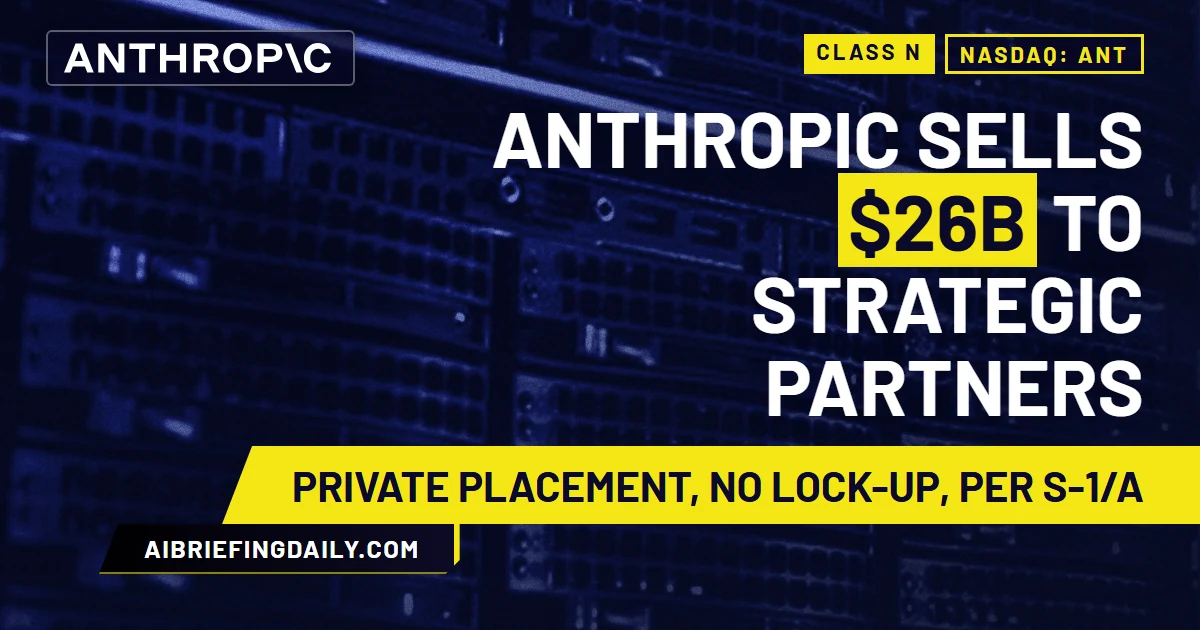
In November 2026, Anthropic agreed to sell $26.0 billion of Class N stock in a private placement, at the IPO price, to strategic partners including Google and AMD, according to the filing's notes. CNBC names seven buyers: AMD, Broadcom, Google, Micron, Microsoft, Nvidia and TSMC.
The filing gives two amounts. Google's $10.0 billion reduces what's left under its 2026 note purchase agreement to $10.0 billion. AMD's $2.5 billion cuts its remaining equity commitment under its Hardware Supply Agreement to $2.5 billion. That's $12.5 billion of the total; the filing text we read doesn't split the other $13.5 billion among the remaining five.
The placement shares are restricted securities, some buyers have registration rights, and they sit outside the underwriters' lock-up agreements. The company says the purchases happen right after the IPO closes. Several of these buyers also sit on the supply side of the $895.4 billion of compute commitments, so they would be paid by Anthropic and own part of it.
The board belongs to a trust
Control of the board runs through yet another class. Class T, also a single share with no economic rights, lets the Long-Term Benefit Trust elect and remove the directors who make up a majority of the board. Anthropic is a public benefit corporation, so directors must weigh shareholders' financial interests against the public benefit the filing defines as "the responsible development and maintenance of advanced AI for the long-term benefit of humanity."
The filing calls Anthropic a "controlled company" under Nasdaq rules, which allows exemptions from some governance requirements. It says it doesn't expect to lean on that except for the nominating and corporate governance committee, which won't be fully independent. The board is currently a majority of independent directors, and the audit and compensation committees are fully independent.
Before you read the valuation headlines
The roadshow's own number is the least informative one. Check three things in the prospectus instead: which Founder LLC conditions would end the 50.1%, when the Class N and other lock-ups expire, and how many Class N shares could turn into Class A on the open market. Pricing is expected on Nov. 18 and first trade on Nov. 19, per CNBC's sources, which gives you about a week to read them.
Source: SEC filing (S-1/A)
Latest
- 01Anthropic IPO: $70-$80 Price Range Pulled at RoadshowBusiness · 2026-11-10
- 02Project Zenith on AMD Ryzen AI Halo: Windows 11 Dev PCProducts · 2026-11-10
- 03Nvidia Class Action Over Huang Disclosures: What It SaysBusiness · 2026-11-10
- 04Claude Fable 5.2 in GitHub Copilot: Admin Opt-In, PricingProducts · 2026-11-10
- 05Jensen Huang and Megaspeed: The Full Timeline, Claim by ClaimBusiness · 2026-11-09