Project Zenith on AMD Ryzen AI Halo: Windows 11 Dev PC
Project Zenith, Microsoft's ready-to-code Windows 11 setup, now ships preinstalled on AMD's Ryzen AI Halo. What's in it, the 64GB bar and the $7,300 price.
Key points
- AMD said on Nov. 9, 2026 that Project Zenith, Microsoft's preconfigured Windows 11 for developers, is now preinstalled on the Ryzen AI Halo with the Ryzen AI Max+ PRO 495
- Zenith is a setup, not a new Windows edition: curated tools, coding-friendly settings, and a hardware floor of 64GB+ unified memory and 250GB/s+ bandwidth
- Halo offers up to 192GB of memory and 273GB/s of bandwidth, enough for models of up to 300B parameters, per AMD
- The 495 version listed at $7,299.99 in October, $3,300 above the original 128GB model, and Micro Center's own tests show single-digit speed gains
- Owners of an existing Halo can copy the setup through Microsoft's Windows Developer Config on GitHub
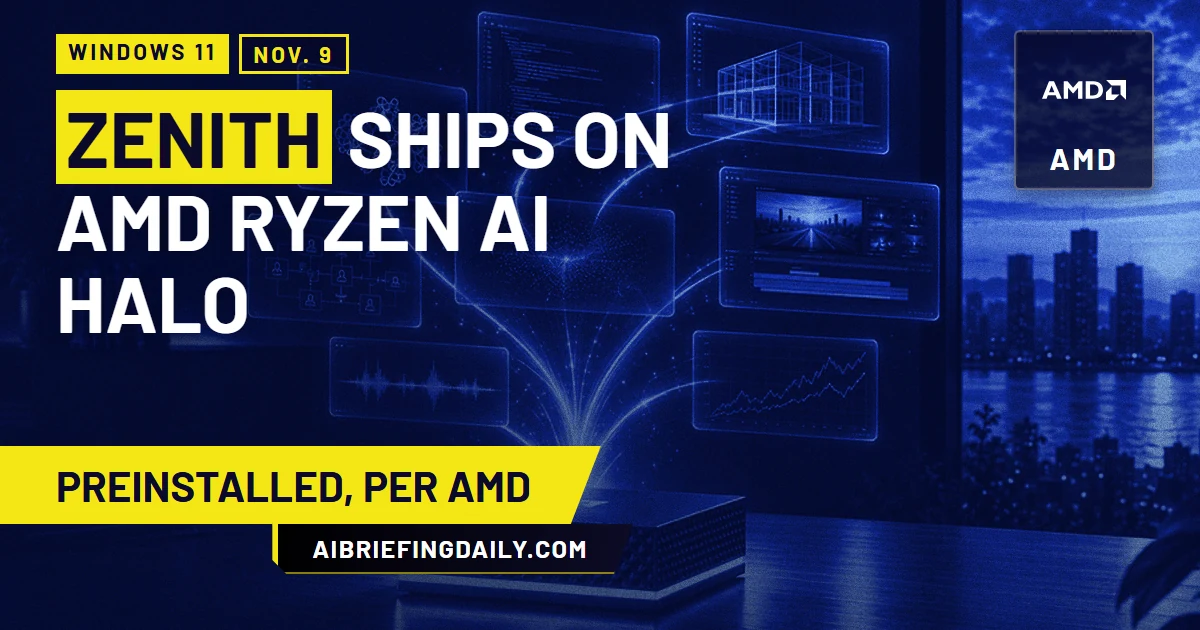
AMD's Ryzen AI Halo, the company's small desktop box for local AI work, now ships with Windows 11 set up as a developer machine from the first boot. AMD announced it on Nov. 9, 2026: Project Zenith, Microsoft's ready-to-code Windows configuration, is available "starting today" preinstalled on the new Ryzen AI Halo built around the Ryzen AI Max+ PRO 495 chip.
The announcement is short on drama and long on detail, so here's what's actually in the box, what Zenith does and doesn't change about Windows, and what the hardware costs.
AI at AMD's post on X, Nov. 9, 2026, announcing Project Zenith on Ryzen AI Halo (@AIatAMD)
Zenith is a starting point, not a new Windows
Microsoft first described the idea on Sept. 4, 2026, when Logan Iyer, the corporate vice president for Windows platform and developer, introduced it on the Windows Developer Blog as "a ready-to-code distraction-free Windows experience on developer-class devices." Windows Central's reading, a few days later, was that this isn't a new version of Windows 11: the device still ships with Windows 11 Home or Pro, and what differs is the configuration.
That configuration is specific. File Explorer shows file extensions, hidden files, the full path in the title bar and the details pane, with long-path support turned on. Recent files and sync-provider tips are switched off, Command Palette is enabled in Search and Start, and Start menu tips and account notifications are muted. Windows Terminal and Visual Studio Code are pinned to the taskbar.
AMD's list of preinstalled software adds Git, GitHub CLI, GitHub Copilot CLI, Azure CLI, Python, Node.js, .NET, PowerShell 7 and Windows Subsystem for Linux. Our reading: each item is a small save on its own, but together they remove the half-day of installs that a new Windows developer machine usually costs.
What AMD adds on top
AMD layers its own software over the Windows baseline: the Ryzen AI Developer Center, a hub that manages preinstalled software and syncs it to AMD's validated configuration, plus AMD AI Playbooks, guided end-to-end workflows. The blog names five: running LLMs with PyTorch and ROCm, image generation with ComfyUI, local coding with VS Code and Qwen3-Coder, serving models through LM Studio, and workflow automation with n8n and local LLMs. AMD says new playbooks arrive monthly. It's the same developer-onboarding push we covered when AMD added one-click tutorials to its Developer Hub.
"Choose the models. Choose the frameworks. Customize the environment. Build locally, work with the cloud, or use a combination of both." — AMD, Project Zenith announcement, Nov. 9, 2026
The 64GB bar and where Halo lands
Zenith comes with a hardware floor. Microsoft says qualifying devices need 64GB+ of unified memory and 250GB/s+ of memory bandwidth, and that on them developers can run 30B+ parameter models locally and unmetered, reducing reliance on metered cloud tokens.
Set side by side: the original Halo, with the Ryzen AI Max+ 395, has 128GB of memory and listed at $3,999.99 at launch in June. The 495 version has up to 192GB, 160GB of it usable by the graphics side, 273GB/s of bandwidth and a ceiling of 300B-parameter models, per AMD. Microsoft's minimum for the Zenith label is 64GB+ and 250GB/s+.
The 495 box clears the bar by a wide margin on memory and by about 9% on bandwidth (273 against 250, our calculation). Microsoft says more devices from OEM and silicon partners will follow "in the coming months," which is where the 64GB floor starts to matter: it's what decides whether a cheaper machine can carry the Zenith label.
The $7,300 question
AMD's announcement doesn't state a price. The number comes from retail: VideoCardz, citing Micro Center, reported on Oct. 12 that the 192GB, 2TB Ryzen AI Halo was listed at $7,299.99, in store only, in its Linux configuration, with the Windows model with Zenith expected later. That listing is $3,300 above the original Halo, which launched in June at $3,999.99 with 128GB. AMD's Nov. 9 post is the first to say the Zenith build is shipping, and it points buyers to Micro Center or its online store; it doesn't list a separate price for it.
Our math, both recalculated: $7,299.99 over 192GB is about $38.02 per GB, against $31.25 for the 128GB model. The extra 64GB costs about $51.56 per GB. That's a premium for capacity, and Micro Center's hands-on testing suggests that's the point: generation speed on one model rose from 51.2 to 52.2 tokens per second (about 2%), and prompt processing was about 1.7% faster. The tests used different memory carve-outs on the two machines, so they compare the boxes as shipped, not chip against chip.
Our reading: The upgrade buys room, not speed. If your models already fit in 128GB, the benchmarks give little reason to pay $3,300 more. If you want 100B+ parameter models and long contexts on one desk, the extra memory is the product.
If you already own a Halo
AMD says a Ryzen AI Halo that already runs Windows can get "the same environment" through Microsoft's Windows Developer Config on GitHub, so Zenith doesn't require new hardware to copy. That's also the practical test of the idea. If most of the value is a list of settings and installs, it travels to any Windows 11 PC; what's exclusive to the Halo box is the memory and the AMD software on top.
What to check before you buy
Three things are worth confirming at checkout, since the public record is thin: whether the Windows configuration with Zenith is the one in stock, its price, and which model sizes it holds in practice at the context length you use. AMD's 300B-parameter figure is a ceiling for the 192GB machine, not a promise for every workload.
Microsoft has promised more Zenith devices "in the coming months." When the first one under $7,000 arrives, the 64GB floor will tell you whether it's a developer PC or a Windows PC with a developer wallpaper.
Source: AMD
Latest
- 01Anthropic IPO: $70-$80 Price Range Pulled at RoadshowBusiness · 2026-11-10
- 02Nvidia Class Action Over Huang Disclosures: What It SaysBusiness · 2026-11-10
- 03Claude Fable 5.2 in GitHub Copilot: Admin Opt-In, PricingProducts · 2026-11-10
- 04Jensen Huang and Megaspeed: The Full Timeline, Claim by ClaimBusiness · 2026-11-09
- 05OpenAI Control Room: 35 Seconds to Stop a Model JobWorld · 2026-11-09