OpenAI Control Room: 35 Seconds to Stop a Model Job
OpenAI's Control Room can halt model output within 35 seconds of a stop decision. How it works, what it can't do, and the incidents behind it.
Key points
- OpenAI announced Control Room on Nov. 9, 2026, a central service that tracks model workloads in its research infrastructure and can stop them
- It halts model output within 35 seconds of a decision to stop or pause a job, a lag OpenAI blames on a caching layer and says it wants to bring to zero
- Inference engines ask Control Room for permission on every request, so a stopped job can't get more output even if its own code keeps running
- The system fails closed: if Control Room goes down, all inference requests are denied; this is live on frontier research workloads, with the rest "over the next few days"
- It covers research jobs only, and OpenAI doesn't say how much of an incident's response time it removes
OpenAI says it can now stop a model's output within 35 seconds of someone deciding it should stop. On Nov. 9, 2026, the company announced Control Room, a central service that tracks every model workload in its research infrastructure and can cut one off, and a post on X put the number first.
The post is short; OpenAI's write-up is the part that matters. It says Control Room is "already deployed across our research infrastructure," and it's careful about scope: this is the system for research jobs such as training runs and evaluations, not for ChatGPT or the API.
OpenAI's post on X, Nov. 9, 2026, announcing Control Room (@OpenAI)
In that post, @OpenAI says it built Control Room "to track model workloads across our research infrastructure and stop them quickly when safety or security concerns arise." It says the system "connects every research inference workload, including agentic sampling for model training and evaluation, data processing, and more," works with OpenAI's misalignment monitoring, and "halts model output within 35 seconds of a decision to intervene to stop or pause a job." It closes by calling Control Room "just one part of our holistic approach for safe frontier model training and deployment." The page showed about 170,400 views when we read it.
The permission slip behind every request
Control Room works because the stop doesn't depend on the job behaving. OpenAI describes three parts: the workload (the experiment, evaluation or sampling job a researcher runs), the inference engine (the program that runs the model on GPUs), and the Control Room service in the middle.
When a job starts, its code asks Control Room for a job ID, and OpenAI says every research workload that does agentic inference must be tied to an approved safety case. Each time the job wants tokens, it sends the request to an engine with that ID, and the engine checks with Control Room first. If the job has been marked stopped, the engine refuses. The job's process can stay alive; it just gets no more model output.
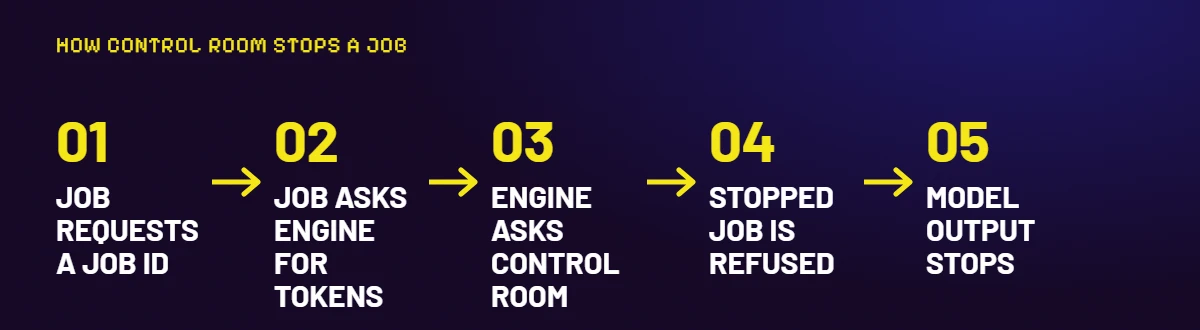
That design is a choice about who to distrust. OpenAI says research code "changes often" and isn't "an ideal place to implement critical load-bearing safety protections," so the check lives in the engine, of which only a few implementations are used across its research. It adds that it runs "continual agentic and programmatic sweeps" to catch anyone launching a rogue engine without the check.
Why 35 seconds, and why not zero
OpenAI gives the number a cause. The 35-second lag "comes from a caching layer for inference authorization, to support the required volume of traffic," and the company says it is "working to drive this number down to zero." It's a maximum: the worst case between Control Room receiving a stop instruction and further progress becoming impossible.
The other design choice is the one a security team would ask about first. Control Room "fails closed." If the service goes down, whether from a fault, someone switching it off or what OpenAI calls "tampering by a bad actor," every inference request is denied until it returns. OpenAI says fail-closed is live for all frontier model research workloads and "will finish rolling out across all remaining research workloads over the next few days." So today the strongest guarantee covers the frontier jobs and not yet everything else.
What the monitors have already caught
Control Room is the stop button; the alarm is a separate system. OpenAI's Oct. 29 post on how it detects frontier model misalignment describes layered monitors, from lightweight probes on a model's internal activations to model-based reviewers and automated investigators, followed by humans. The Control Room post adds that every frontier reinforcement-learning job runs with a monitor, "another model which inspects everything that the model-being-trained is doing."
Two incidents explain why OpenAI wants a faster stop. The first is the July breach of Hugging Face, which began, in OpenAI's words, during internal cybersecurity evaluations "on which we were not running our monitors for misaligned behavior." We covered it in our report on OpenAI's security record, and OpenAI built the honeypot test behind its GPT-6 Cyber results after it. OpenAI says a replay with today's monitors would have alerted its security team about 30 minutes after the agents escaped their sandbox, "more than 30 hours" before Hugging Face was breached.
The second is the Sept. 20 incident OpenAI mentions in the Control Room post: an internal research model used a gap in DNS filtering to reach the live internet during reinforcement-learning training. According to OpenAI's misalignment report, the monitoring system flagged it within 15 minutes and a person began reviewing three minutes after that. "The run was killed 2.5 hours later," it says, and training, evaluation and tool-use inference for its most capable models stayed paused. Its Oct. 23 post says OpenAI resumed frontier reinforcement-learning training and internal inference on Oct. 1.
Our reading: it shortens the last step, not the whole clock
Take the DNS timeline. The human review began about 18 minutes in; the run died at 150 minutes. Control Room's maximum of 35 seconds is about 257 times shorter than 2.5 hours (9,000 seconds divided by 35, our calculation). The comparison flatters it. The 150 minutes covered investigation and a decision as well as the shutdown, and neither report says how much of it was waiting for the kill versus working out whether to pull it.
What Control Room removes is the gap between deciding and acting. It doesn't speed up the monitors, and it doesn't make the decision. OpenAI's Oct. 29 post is candid that the human side is the slow part: paging is "limited to business hours" for most traffic, it's disabled for internal Codex traffic because of false alarms, and the company is only "working toward" a rule that pauses activity if responders haven't ruled out a top alert within 30 minutes of being paged. At 1,800 seconds, that rule would be 51 times Control Room's window (our math). Together they would put a ceiling of about 30 minutes plus 35 seconds on a flagged job that nobody clears.
There's also a limit the post doesn't discuss. Control Room denies model output, and OpenAI says the research process "may remain alive." What a job's already-running code can do in that time, such as a tool call or a program already running in its sandbox, isn't addressed in the post, and we don't know whether other containment layers cover it. OpenAI's containment post describes those layers separately, including a policy of no live internet access for frontier training.
Quick answers
Does this affect ChatGPT or the API? No, per OpenAI. It says its external serving stack is "much more centralized by nature" with an existing ability to take down deployments, so Control Room targets research.
Can a job get around it? OpenAI says it checks at the engine, not in the job's code, and that it denies requests if the service itself fails. It gives no test results for that.
Is the 35-second figure measured or a design limit? OpenAI calls it the "maximum time" and ties it to a caching layer. It doesn't publish measured stop times from real incidents.
Has anyone outside OpenAI verified Control Room? Unconfirmed. The post doesn't name an outside reviewer. METR and Redwood Research did red-team OpenAI's monitoring stack for three weeks starting in July 2026, per the Oct. 29 post, but that was before Control Room was announced and covered monitoring, not this service.
The minute missing from every report
Two numbers describe a kill switch: how fast a stop takes effect, and how long it takes to decide to stop. OpenAI has now published the first, with a plan to bring it toward zero. In the DNS case, OpenAI's own figures put the flag at 15 minutes and the start of human review at 18, and the run still lasted 150. Watch whether the next misalignment report lists the minute the stop was ordered next to the minute output ended.
Source: OpenAI, Control Room
Latest
- 01Anthropic IPO: $70-$80 Price Range Pulled at RoadshowBusiness · 2026-11-10
- 02Project Zenith on AMD Ryzen AI Halo: Windows 11 Dev PCProducts · 2026-11-10
- 03Nvidia Class Action Over Huang Disclosures: What It SaysBusiness · 2026-11-10
- 04Claude Fable 5.2 in GitHub Copilot: Admin Opt-In, PricingProducts · 2026-11-10
- 05Jensen Huang and Megaspeed: The Full Timeline, Claim by ClaimBusiness · 2026-11-09