Jensen Huang and Megaspeed: The Full Timeline, Claim by Claim
Jensen Huang and Megaspeed timeline: from Nvidia chip buys to the board probe, with each point in voidzilla's viral video lined up against the sources.
Key points
- Nvidia shares fell more than 4% on Nov. 9, 2026, erasing almost $200 billion, after the board said it is investigating reports that CEO Jensen Huang was the target of a foreign intelligence effort
- The story has three layers that get mixed up: Huang's admitted personal conduct, an unproven spy allegation resting on unnamed officials, and a documented dispute over where a Singapore customer's Nvidia chips went
- Megaspeed, the customer, became Southeast Asia's largest Nvidia buyer in under three years; Bloomberg reported in December 2025 that it had imported far more chips than Nvidia saw in its data centers
- A $2.5 billion export case in March 2026 used dummy servers, but it charged people tied to Super Micro and, as reported, doesn't name Megaspeed
- Nobody has been charged in the Megaspeed matter; Nvidia and China deny the spy claims; the next dates are Nov. 11, 17 and 18
Nvidia shares dropped more than 4% on Monday, wiping almost $200 billion off the company's value while the S&P 500 and Nasdaq both rose sharply, NBC News reported. The trigger was a six-sentence statement from Nvidia's board the day before: an independent investigation, prompted by reports that founder and CEO Jensen Huang had been targeted by a foreign intelligence effort.
Update, Nov. 9: a shareholder has since filed a proposed class action against Nvidia and Huang over these statements; here's what the complaint alleges.
That's the headline. The story underneath started more than a year earlier with a chip buyer most people had never heard of, and it has since grown into three separate questions that keep getting merged: what Huang did, what a woman named Alice Huang may have done, and where billions of dollars of restricted hardware went. This is the full timeline, with the source for each step and a marker for what's established and what isn't.
A YouTube video by the creator voidzilla, which had about 562,000 views when we checked, is what made many people look, and the reporting backs its core. In roughly 15 minutes it walks through the same chronology and argues that Nvidia "may have been lying about all of this," that Alice Huang is "a Chinese spy," and that the affair is the smaller part of the story. The dates, the chip numbers, the indictment and the officials' spy allegation are all on the record below; where officials have only alleged something, we say who alleged it.
Where it started: a spinoff nobody was watching
Megaspeed International is a Singapore AI-cloud company. Bloomberg described it in December 2025 as "the once-obscure spinoff of a Chinese gaming enterprise" that became "the single largest Southeast Asian buyer of Nvidia Corp. chips" in less than three years. Igor's Lab's summary of the Times investigation names the gaming parent as 7Road and says Megaspeed's managing director, Alice Huang, was seen with Jensen Huang at Computex in Taiwan in 2024. NBC published a photo of the two in Taipei that year, and ABC News says the pair were pictured together in 2024.
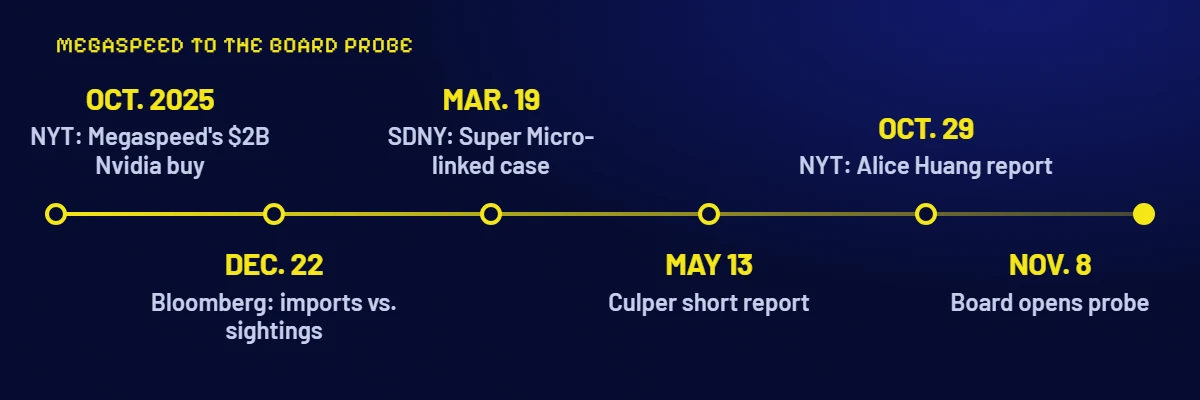
The Times investigation in October 2025 reported that Megaspeed and a Malaysian subsidiary had bought around $2 billion of Nvidia hardware, and that U.S. and Singapore authorities were looking at whether it was reaching Chinese customers. Singapore's authorities confirmed to the Times that Megaspeed is under investigation for possible violations of local law, per the same summary, and Nvidia rejected any connection to China. The video quotes the company's line that Megaspeed was "wholly owned and operated by a company based and headquartered outside of China with no China shareholder"; the video quotes it from the Times investigation, which sits behind a paywall, so we cite it as the video presents it.
The numbers that didn't add up
Bloomberg's December 22, 2025 feature is the first piece that gives the dispute a shape. The paywall stopped us at the lead, but reporter Mackenzie Hawkins summarized it on X: Nvidia's biggest Southeast Asian partner "imported tens of thousands more AI chips than Nvidia saw in its data centers." Reprints of the story put the totals at $4.6 billion and 136,000 GPUs, more than half of them Blackwell chips, based on Malaysian and Indonesian customs data, against a few thousand Blackwell chips seen when Nvidia visited. The video cites the same numbers, and they match the reprints; Bloomberg's own text is paywalled, so we attribute them to those reprints.
Nvidia's position, as the video and the reprints put it, is that it inspected the sites and found no diversion. In a Bloomberg interview published Oct. 29, 2026, Huang repeated it: "We've studied all their deployments of our GPUs and counted every one," per Reuters' summary of that interview. The New York Times later put the Malaysian affiliate's purchases at more than $4.8 billion over two years, a figure we first cited in our report on the board's statement.
A separate case with the same trick
On March 19, 2026, federal prosecutors in the Southern District of New York unsealed an indictment against three men linked to Super Micro Computer: co-founder Yih-Shyan "Wally" Liaw, 71, and Ting-Wei Sun, 44, were arrested, and Ruei-Tsang Chang, 53, remains at large, Fox News reported. Prosecutors say $2.5 billion of AI servers were diverted to China, including $510 million in a few weeks in 2025, using false documents, "dummy servers" staged to fool inspectors, and a hair dryer to move labels. Super Micro said it isn't a defendant and put the two employees on leave.
"The indictment unsealed today details alleged efforts to evade U.S. export laws through false documents, staged dummy servers to mislead inspectors, and convoluted transshipment schemes, in order to obfuscate the true destination of restricted AI technology — China." — John A. Eisenberg, Assistant Attorney General for National Security, Mar. 19, 2026
This is the video's strongest point: prosecutors did charge people for doing "exactly what Jensen said was basically impossible," in the video's words, and the method matches the one suspected at Megaspeed. One precision for readers: the men charged are linked to Super Micro, an American server maker, and the Fox report of the indictment doesn't name Megaspeed. The link to Megaspeed was drawn later by a short seller (below).
A landlord, then a short seller
Bain Capital's Bridge Data Centers told lenders in February that Megaspeed would no longer occupy its Malaysian campus, and Bloomberg reported it in April, with Tom's Hardware relaying that the memo "did not specify any reason." The video ties the exit to the dummy-server scheme. The memo itself gave no reason, so that link is the video's reading of the timing.
On May 13, 2026, Culper Research published a 40-page short report called "The China Problem." As Benzinga summarized it, Culper claims more than 20% of Nvidia's fiscal 2026 compute revenue came from Chinese demand through Southeast Asian intermediaries, that Megaspeed is secretly financed by Alibaba through shell companies, and that its balance sheet jumped from $33 million to $3 billion in a year on $2.9 billion of "refundable deposits." Culper also links the March indictment to Megaspeed as "the tip of the iceberg." Culper is betting against Nvidia, so those are an interested party's claims, not findings.
Three questions get blended in this story. (1) Huang's personal conduct: he admitted it himself. (2) The spy allegation: it rests on unnamed officials and is denied by Nvidia and China. (3) The chip counts: they rest on customs data, an indictment of other people and a short report, and none of it has been tested in court. The third can be true or false whatever happens with the first two.
Oct. 29: the story changes
On Oct. 29, 2026, the Times reported that U.S. intelligence officials concluded Alice Huang, a Megaspeed executive, had "developed a close relationship" with Jensen Huang while funneling information to Beijing, and that President Trump was briefed and took no action, ABC News reported. Nvidia's reply:
"Jensen's interactions with Ms. Huang are not unusual or unexpected. Meetings with customers are part of a CEO's job." — Nvidia spokesperson, Oct. 30, 2026, to ABC News
China's Foreign Ministry spokesperson Guo Jiakun called the reports "baseless and purely slanderous smears against China." Neither Alice Huang nor Megaspeed answered ABC's request for comment. Axios recorded what came next: the Wall Street Journal reported on Oct. 31 that U.S., Singapore and Taiwan authorities all had reason to suspect her; three House chairs asked Huang on Nov. 5 for a briefing; and on Nov. 6 the Times and the Financial Times reported she had been recruited specifically to target Huang, with the FT adding that the two had a romantic relationship, per Axios. We covered the House request in an earlier report.
On Sunday, Nov. 8, the board announced its probe, and Huang wrote to employees:
"I was unfaithful to my wife. My actions hurt her and our children. There is no excuse for what I did." — Jensen Huang, in a memo to Nvidia employees shared with NBC News, Nov. 8, 2026
NBC adds that a person familiar with the matter said U.S. agencies had determined Alice Huang was a Chinese spy and had a relationship with him. NBC hasn't confirmed the reports that a foreign intelligence effort targeted Huang. The board says it has "no reason to believe that either national security or NVIDIA secrets were compromised."
What the video says, and what the sources back up
| What the video says | What the sources show |
|---|---|
| Nvidia is "down 4.5% on the day" | Confirmed by NBC: down more than 4%, almost $200 billion erased, on a strong market day |
| Alice Huang "is a Chinese spy" | Matches what unnamed U.S. officials told the Times, the FT and NBC's source; no charges so far, and China and Nvidia deny it |
| Prosecutors indicted people for the dummy-server scheme | Confirmed: the March 2026 indictment charged three men linked to Super Micro; Culper ties the case to Megaspeed |
| Bloomberg: $4.6B, 136,000 GPUs, a few thousand seen | Matches reprints of Bloomberg's December 2025 story |
| Megaspeed's landlord removed it | Confirmed by Bloomberg and Tom's Hardware; no reason was stated, and the video connects it to the dummy servers |
| Huang lied when he called the dealings normal | Nvidia called the contact routine; Huang's own memo later admitted infidelity; what was known and when is the board's question |
| Culper's report points to Nvidia knowing | The report exists and says so; Culper is short the stock and Nvidia disputes it |
| A June 2024 Taipei scene started it | NBC and ABC confirm the 2024 Taipei photo of the two; the bar scene itself is widely shared on social media |
Two of those rows deserve more than a cell. On "lied," the video's suspicion is understandable, because the sequence is uncomfortable. Our reading is that it's the right question rather than a settled answer: Nvidia's statements were about business contact, Huang's memo admits a personal matter, and whether those are the same facts is what the board's counsel will have to establish. And the video is right that the board's wording, "no reason to believe" anything was compromised, shows its starting assumption, though that's standard phrasing for a company while a review is open.
What it means for investors, Washington and chip exports
For investors, the board probe matters because Nvidia has no public successor to Huang, a point analysts raised in our report on Wall Street's reaction. One update to that piece: NBC's Monday figure, a drop of more than 4% on a day the broad market rose, is clearer than the mixed overnight numbers we had then.
For Washington, the personal story is a handle for an older argument about export controls. Sen. Chris Coons has promised that Congress will investigate the Times report, and the House chairs want to know "the extent to which U.S. national security has been placed at risk." Nothing public shows that any secret reached China; the board and Nvidia both say there's no sign of it.
For anyone tracking chips, the useful test is narrower than the headlines. Either Megaspeed's GPUs are in the data centers Nvidia says it counted, or they're not. A regulator, an auditor or the board's counsel can settle that with serial numbers, and so far none has published a result.
Nov. 11 is Huang's deadline to answer the House chairs. Nov. 17 is Nvidia's third-quarter earnings call, the first place analysts can ask about the probe. Nov. 18 is the proposed closed-door briefing. The number to watch is the one nobody has published yet: how many Megaspeed GPUs Nvidia's own inspectors counted, site by site.
The short answers
What happened? Nvidia's board opened an independent investigation on Nov. 8, 2026, after reports that U.S. intelligence believes a Megaspeed executive cultivated CEO Jensen Huang for Beijing. Huang admitted he was unfaithful to his wife.
Who is Alice Huang? A Chinese citizen and Megaspeed executive, not related to Jensen Huang. Sources differ on her name and exact role; some reports also give it as Huang Le.
Where did it start? With questions about Megaspeed's chip purchases, reported by the New York Times in October 2025, and with a photo of the two in Taipei in 2024.
Has anyone been charged? No one in the Megaspeed matter. The March 2026 indictment concerns people linked to Super Micro.
Was information passed to China? Unconfirmed. The board says it has no reason to believe so, and officials told the Times they didn't think Huang knew of any spying.
Source: NBC News
Latest
- 01Anthropic IPO: $70-$80 Price Range Pulled at RoadshowBusiness · 2026-11-10
- 02Project Zenith on AMD Ryzen AI Halo: Windows 11 Dev PCProducts · 2026-11-10
- 03Nvidia Class Action Over Huang Disclosures: What It SaysBusiness · 2026-11-10
- 04Claude Fable 5.2 in GitHub Copilot: Admin Opt-In, PricingProducts · 2026-11-10
- 05OpenAI Control Room: 35 Seconds to Stop a Model JobWorld · 2026-11-09