DeepSeek Harness Plugins: 35,000 Built, 1.54M Daily Users
DeepSeek says Harness has 1.54M daily users and ~35,000 plugins, with a marketplace and author grants planned. What we could verify, and what isn't built yet.
Key points
- DeepSeek says Harness hit 1.54 million daily users and about 92 trillion tokens a day as of Nov. 4
- It counts roughly 35,000 third-party plugins, and about 60% of active users have built or installed one
- An official plugin marketplace and a support program with token grants are announced, not launched
- Our npm check found 13,459 packages tagged dsh-plugin, and a community-built plugin market already exists
- DeepSeek's own docs say plugin indexes are not checked for what they claim
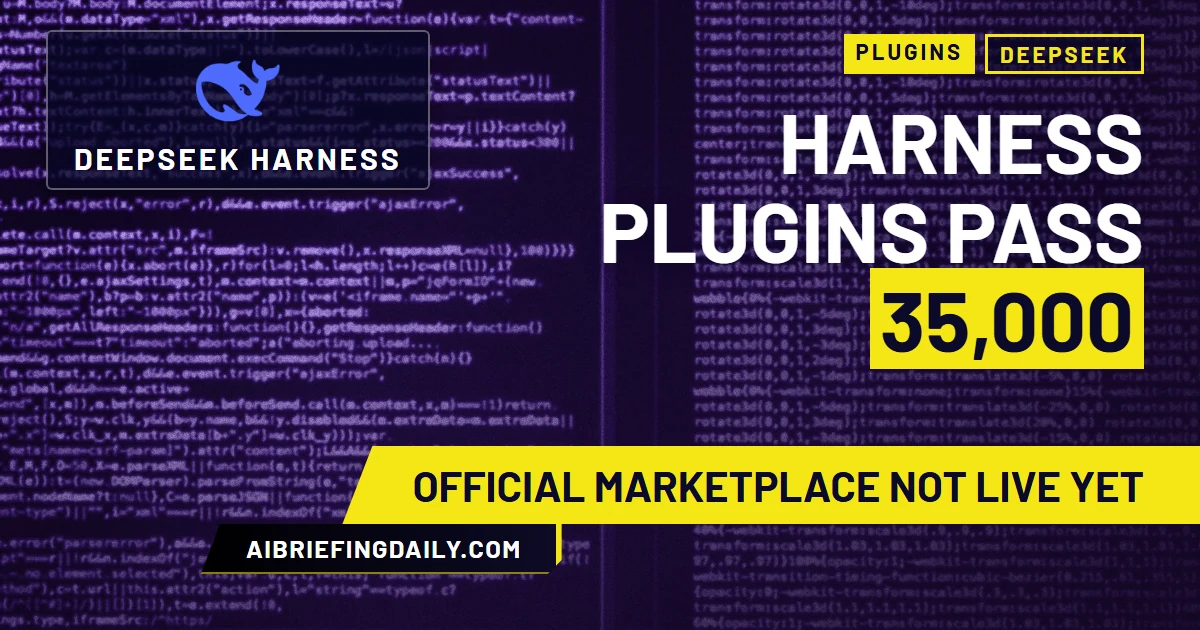
On Nov. 8, the DeepSeek Harness account posted nothing but a link. It pointed to a long X article titled "Growing Together with Our Plugin Community," and the numbers inside are the first usage figures the team has given for its open-source agent runtime: 1.54 million daily active users, roughly 92 trillion tokens a day, and about 35,000 third-party plugins.
Those are DeepSeek's own figures, and they come with a plan attached: an official plugin marketplace, a support program for plugin authors, and tighter plugin security. None of those three exists yet. Below is what the article says, what we could check against public data, and what it means if you build or install DeepSeek Harness plugins.
The DeepSeek Harness post that links to the plugin-community article (@DeepSeekHarness)
The numbers, and how DeepSeek counted them
According to the article, DeepSeek Harness v0.1 went live Aug. 13 and the desktop app followed on Sept. 29. "As of November 4, counting users on the official API," it says, Harness reached 1.54 million daily active users consuming about 92 trillion tokens per day. The qualifier matters: people running Harness against other model providers aren't in that count.
Dividing one by the other, our own arithmetic, gives about 60 million tokens per user per day. That's far more than a person chatting would ever type or read, and it fits agents that loop, read files and call tools on their own. It also means a handful of heavy users could move the total a lot, and the article never says how the 1.54 million is spread.
The open-source repository tells a parallel story. On Nov. 8 the GitHub project showed 276,369 stars and 33,836 forks under an MIT license, 87 days after it was created on Aug. 13. A star counts interest rather than usage, but the repository is clearly past the point of being a side project.
35,000 plugins: what we could and couldn't confirm
The article says third-party plugins have grown to "roughly 35,000," and that about 60% of active users have built or installed at least one. It then adds a caution: community plugins "vary in maturity and in the scenarios they serve."
We can't reproduce the 35,000. DeepSeek doesn't say where it counts from, and it may include Git-hosted plugins that no registry lists. What we can see is the npm registry, where a search for the dsh-plugin keyword returned 13,459 packages on Nov. 8. That's a floor for one distribution channel, not a rebuttal. It does suggest the 35,000 is a generous, all-sources number, and that a good share of plugins live outside npm or lack the tag.
The averages hide a long tail. In the same search, the top five results pulled between 293,000 and 1.09 million downloads in a month. We'd expect most of the thousands of packages below them to have far fewer users.
Doing the math on pace: 35,000 plugins in the 83 days from Aug. 13 to Nov. 4 works out to about 420 new plugins a day, by our calculation. That's what you'd expect when the runtime's slogan, in the repository description, is "Everything is a Plugin."
Four plugins DeepSeek chose to show off
The article profiles four community plugins, each with an author quote. We checked that all four are published on npm today.
- dsh-media-desk is a creator workbench for scripts, cover images and storyboards (MIT license, version 2.6.2).
- dsh-guizang-design bundles four design and copy-polishing skills to turn an article into a web page, image card or cover. It's licensed AGPL-3.0, the strictest license in the group, which matters if you plan to build it into a product.
- dsh-context shows what an agent's context contains and how it changes, including in multi-agent setups (Apache-2.0, version 0.83.0).
- agentero-dsh connects the Agentero paper-reading tool to Harness for highlighting, translation and notes. Its npm listing shows no license, so check before reuse.
The pattern is worth noticing: three of the four are tools for working with content or context, not for writing code. DeepSeek is steering attention toward Harness as a general work surface, not only a coding agent.
The marketplace is promised, and one already exists
DeepSeek says it will improve the plugin API's stability and compatibility, strengthen plugin security, and "build an official plugin marketplace where developers can easily publish their plugins and users can easily find the ones they need." The support program will offer token grants, technical discussions and promotion, with rules "announced when the program officially launches." For now, the only thing live is an interest form for authors.
Meanwhile, the community moved first. The npm package dshmarket describes itself as a visual plugin market inside DeepSeek Harness, and it showed about 1.09 million downloads in the last month, more than any of the other four top results in that search. An official marketplace will have to beat something users already have installed.
DeepSeek's own repository shows where the official version stands. The plugin index guide says Harness "ships no index source." A "Custom plugin indexes" bundle is experimental and off until you turn it on, and you add each index URL yourself.
A catalog nobody checks
The same guide warns that indexes are third-party content: an index "chooses each plugin's title, description, icon, author, and source; DSH checks the file format but not those claims." The install confirmation, which shows the npm package or Git commit, is the only gate.
That was a manageable risk when plugins were a few hundred. At 35,000, and with about 60% of active users having installed one, it's a bigger target. Our reading: "strengthen plugin security" is the most consequential promise in the article and the one with the least detail. Nothing says whether the marketplace will review code, sign packages or limit what a plugin can touch. Two earlier changes show why that matters. Harness 0.2.2 shipped with its read-before-write file check switched off, and agent plugins run with the permissions you give them.
Where the Super-agent fits
Plugins are also how DeepSeek's own experiments ship. The team's always-on Super-agent design, sometimes searched as "super agent," "superagent" or "super harness," was released as an optional prototype plugin, not a core feature. The new article makes the same bet in public: general features stay in the core, and "specialized workflows, specific industries, and individual preferences" go to plugin authors. DeepSeek says it wants Harness to be "the operating system of the agent era," and that built-in features can themselves be replaced by third-party plugins.
Before you install your next plugin
If you use Harness, treat the 35,000 as a menu with no inspection. Look at the plugin's license, its last publish date and its download count on npm, read what permissions it asks for, and test it in a throwaway profile first. If you're thinking of publishing one, the unanswered questions are the ones that decide whether the program is worth your time: how large the token grants will be, who gets promoted, and whether the official marketplace can list a plugin that a community market already carries. DeepSeek says the details "will take shape as we learn more." The interest form is the only way in for now.
Source: DeepSeek Harness on X
Latest
- 01Anthropic IPO: $70-$80 Price Range Pulled at RoadshowBusiness · 2026-11-10
- 02Project Zenith on AMD Ryzen AI Halo: Windows 11 Dev PCProducts · 2026-11-10
- 03Nvidia Class Action Over Huang Disclosures: What It SaysBusiness · 2026-11-10
- 04Claude Fable 5.2 in GitHub Copilot: Admin Opt-In, PricingProducts · 2026-11-10
- 05Jensen Huang and Megaspeed: The Full Timeline, Claim by ClaimBusiness · 2026-11-09