Meta Muse Ember: $0.10 Per Million Tokens, Benchmarks
Meta's Muse Ember costs $0.10 input and $0.50 output per million tokens and trails Claude Haiku 5.5 on FrontierCode. Who ran each benchmark, and what it costs.
Key points
- Meta released Muse Ember on Nov. 9, 2026 on its Meta Model API and in Muse Code; model ID muse-ember-1.0
- It costs $0.10 per million input tokens and $0.50 per million output tokens, with a 1M-token context window and up to 512K output tokens
- On Artificial Analysis' index it scores 36, level with Claude Haiku 5.5 and 8 points above GPT-6 Luna, at about $0.14 per task versus $2.39 for Muse Spark 1.3
- It loses to Haiku 5.5 on FrontierCode 2.0-AA, 27.2% to 34.9%, and four of its ten headline rows are Meta's own evaluations
- Requests over 200K input tokens are billed at triple the input rate for the whole request
An agent that fixes one bug can send a model hundreds of small requests: read this file, run that test, patch this line, summarize that log. Meta says Muse Ember is built for exactly that traffic. Meta put Muse Ember, its smallest model, on the Meta Model API and in Muse Code today, Nov. 9, 2026, priced at a dime to read a million tokens and 50 cents to write them.
The price is the headline, and Meta's benchmarks are the argument for it: on the table Meta published, Muse Ember beats Anthropic's Claude Haiku 5.5 and OpenAI's GPT-6 Luna on most rows. It doesn't beat Haiku on all of them, and four of the ten rows were run by Meta itself.
Meta for Developers' post on X, Nov. 9, 2026, announcing Muse Ember (@MetaforDevs)
Meta for Developers' post calls Muse Ember "our smallest, most efficient model" and says it "excels at coding subtasks, tool calls and document analysis," with audio and video inputs alongside text and images. It also tells developers to pair it with Muse Wonder or Muse Spark. Meta's launch blog and model documentation add the specs the post leaves out, and they're what the rest of this piece relies on.
What you actually get for $0.10
The model ID is muse-ember-1.0. It takes text, images, video, audio and PDFs and returns text, has a 1M-token context window and can write up to 512K tokens in one response, according to Meta's blog. The docs say it accepts the same requests as Muse Spark, through the Responses, Chat Completions and Messages endpoints, "at a lower price per token."
Meta's pricing page lists cached input at $0.004 per million tokens, and it also lists a catch that the launch post doesn't mention. Muse Ember has two tiers. A request with up to 200K input tokens pays $0.10 in, $0.50 out. A request with more than 200K input tokens pays $0.30 in and $1.50 out, and per the page that rate applies to the whole request, not just the tokens past 200K. Muse Wonder and Muse Spark carry no such premium, so the "feed it a whole codebase" pitch costs three times the headline rate on the Ember side.
Two more limits from the same page: Ember runs in Standard mode only, so there's no discounted Contributor tier (which trades a lower price for permission to train on your data, and which Spark 1.3 has), and web search is billed separately at $2.50 per 1,000 queries.
Where it sits next to Spark and Wonder
Meta now sells three reasoning models in a ladder. Wonder is the top one, listed as "in preview" in the docs, at $4.00 in and $20.00 out per million tokens. Muse Spark 1.3 is $1.25 in and $4.25 out. Ember is the cheapest rung.
By our math, Ember's input price is 12.5 times lower than Spark 1.3's and 40 times lower than Wonder's; its output price is 8.5 times lower than Spark's and 40 times lower than Wonder's. Take an agent run that reads 10 million tokens and writes 1 million: that's $1.50 on Ember, $16.75 on Spark 1.3 and $60.00 on Wonder at list prices (our calculation, before caching).
Meta's own comparison, built on Artificial Analysis data, shows the gap that matters for the pitch: Ember scores 36 on the Artificial Analysis Intelligence Index against Spark 1.3's 37, at $0.14 per index task versus $2.39. That's about 17 times cheaper per task for one point less. Meta also says Ember is the first model it trained using Muse Wonder Full, which is how a small model gets a big one's behavior.
Ten rows, three referees
Meta compares Ember with Claude Haiku 5.5 and GPT-6 Luna, all at "max" reasoning, across ten rows. Ember (against Haiku and Luna) scores 37.8% to 13.9% and 20.2% on AutomationBench-AA, 46 to 37 and 31 on Coding Agent Index-AA, 40.9% to 39.2% and 16.4% on Terminal-Bench 4.0, 80.6% to 78.6% and 62.8% on PerceptionBench, and 36 to 36 and 28 on the Artificial Analysis Index. On Agents' Last Exam it's 61.6% to 57.0% and 57.1%, and on Meta's Personal Superintelligence Index 46.8 to 36.1 and 37.0.
The pattern is less tidy than "Meta wins." Ember's biggest gap is on AutomationBench-AA, and on GDP.pdf-AA it ties Luna at 22.8% with Haiku at 20.8%. On Meta's OSWorld 2.1 it leads Haiku by 0.6 points on partial credit, which is within what we'd treat as a tie. On the strict binary version of that test, per Meta's table, the scores are 33.8% for Ember, 27.8% for Haiku and 17.0% for Luna.
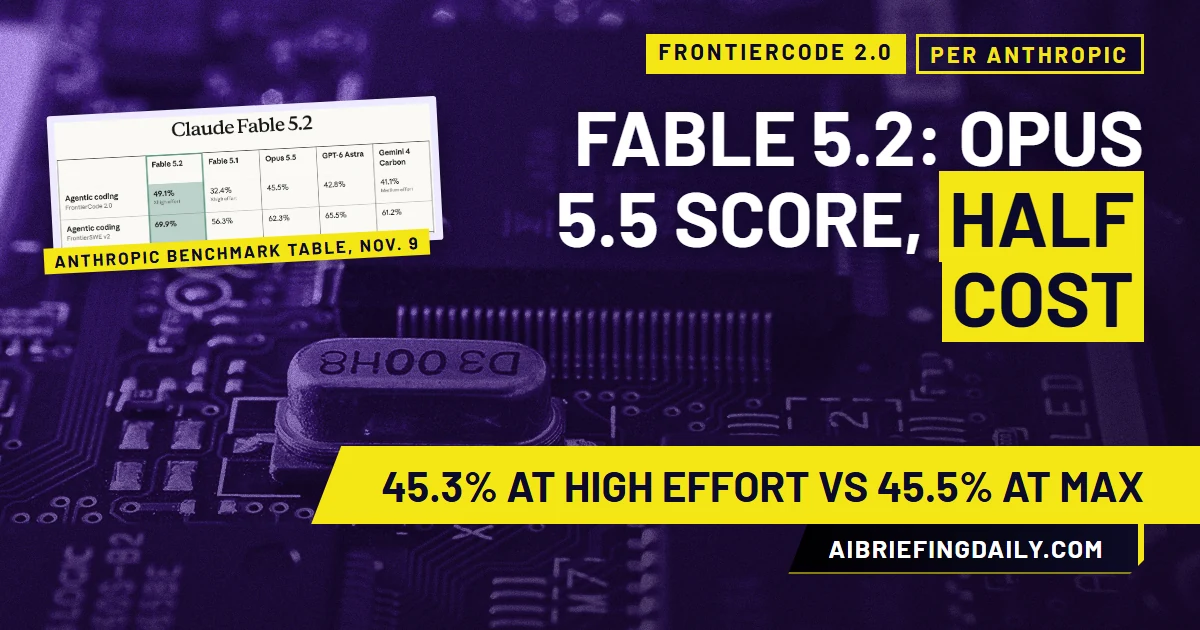
The row that goes the other way is the one closest to day-to-day coding. On FrontierCode 2.0-AA, which Meta describes as real engineering tasks judged on mergeability, Haiku 5.5 scores 34.9% and Ember 27.2%, a 7.7-point gap. Meta's own wording on that row is "for the hardest problems, pair it with Muse Wonder." For comparison, our Claude Fable 5.2 coverage shows the same benchmark family at the high end of Anthropic's lineup.
Meta chooses the rows, too. Five of the ten come from Artificial Analysis, the independent firm; Agents' Last Exam, OSWorld 2.1 and PerceptionBench are marked as Meta's own evaluations, and the Personal Superintelligence Index is an internal composite. The Terminal-Bench row gives each model its best published harness, which isn't the same setup for every model. We haven't seen a separate run of any of these by a party outside Meta and Artificial Analysis.
A third of Haiku's cost, but whose chart is it?
Meta's strongest claim is on cost: Ember "matches Haiku's best score at about a third of the cost and beats every Luna setting." The chart data backs the arithmetic. Haiku 5.5 on its highest setting scores 36.2 at $0.411 per task; Ember at its top setting scores 35.8 at $0.136. That's 3.0 times cheaper by our division, for 0.4 points less. The best Luna setting in the chart, 27.8 at $0.152, sits below Ember on both axes.
Two caveats from the blog itself. The chart legend says Ember's costs are "estimates at proposed pricing," while the footnote says "list pricing"; we couldn't tell from the page which one the plotted costs use. And cost per task is Artificial Analysis' measure of tokens used on its own task set, so a model that thinks longer on your workload can move the number.
What the partners said, and what they sell
Meta's page quotes five companies that tested the model early. Cloudflare's CTO says Ember "ran up to 30% faster at the tail than the comparable model we tested." You.com's inference lead reports a p95 latency of 2.2 seconds on its coding quests, "about 4x to 13x faster than leading open-weight models," with 36 to 48% fewer output tokens. Box points to a contract-review task, Cline's founder calls it a fit for subagent work, and Oracle describes early results as "encouraging."
These are vendor testimonials published on Meta's page, and none says which models or settings the comparisons used. Treat them as a signal about latency, which Meta's benchmark table doesn't cover at all, not as an independent test.
Safety, as Meta rates it
Meta says it evaluated Ember under its Meta Superintelligence Scaling Framework, including chemical and biological, cybersecurity and loss-of-control risks, and found it "below the framework's high-risk thresholds." It adds that the model got the same core safety training as larger ones and was tested for resisting instructions hidden in web pages or tool outputs. That's Meta's assessment of its own model; the post doesn't link a report.
Test it on your slowest, cheapest steps
If you run an agent harness, the sensible trial is narrow. Pick the repetitive steps (file reads, test runs, extraction from long documents) and route only those to muse-ember-1.0, keeping a larger model for planning, as Meta suggests. Judge it by how many outputs you accept per dollar spent, not by benchmark points, and keep every request under 200K input tokens or price it at the higher tier.
Muse Code subscribers have one open question. Meta's plan list names Muse Spark, Muse Wonder and Muse Image in the Everyday tier, and neither the blog nor the plan page says how Ember counts against usage limits.
Vendor-run scoreboards are the pattern across launches this month; our look at OpenAI's GPT-6 Cyber numbers had the same caveat. The check that settles Ember is cheap: run your own 100 routine agent steps through it, and see how many you'd accept without edits.
Source: Meta, Introducing Our Smallest, Most Efficient Model: Muse Ember
Latest
- 01Anthropic IPO: $70-$80 Price Range Pulled at RoadshowBusiness · 2026-11-10
- 02Project Zenith on AMD Ryzen AI Halo: Windows 11 Dev PCProducts · 2026-11-10
- 03Nvidia Class Action Over Huang Disclosures: What It SaysBusiness · 2026-11-10
- 04Claude Fable 5.2 in GitHub Copilot: Admin Opt-In, PricingProducts · 2026-11-10
- 05Jensen Huang and Megaspeed: The Full Timeline, Claim by ClaimBusiness · 2026-11-09