Claude Fable 5.2 and Mythos 5.2: $8 Price, Benchmarks
Claude Fable 5.2 costs $8 per million input tokens, 20% less than 5.1. Where Anthropic's benchmarks lead, where Opus 5.5 still wins, and what Mythos 5.2 adds.
Key points
- Anthropic released Claude Fable 5.2 and Claude Mythos 5.2 on Nov. 9, 2026; they are the same underlying model, and only Fable is open to everyone
- Fable 5.2 costs $8 per million input tokens and $40 per million output, down from $10 and $50 for Fable 5.1 (20% less by our math)
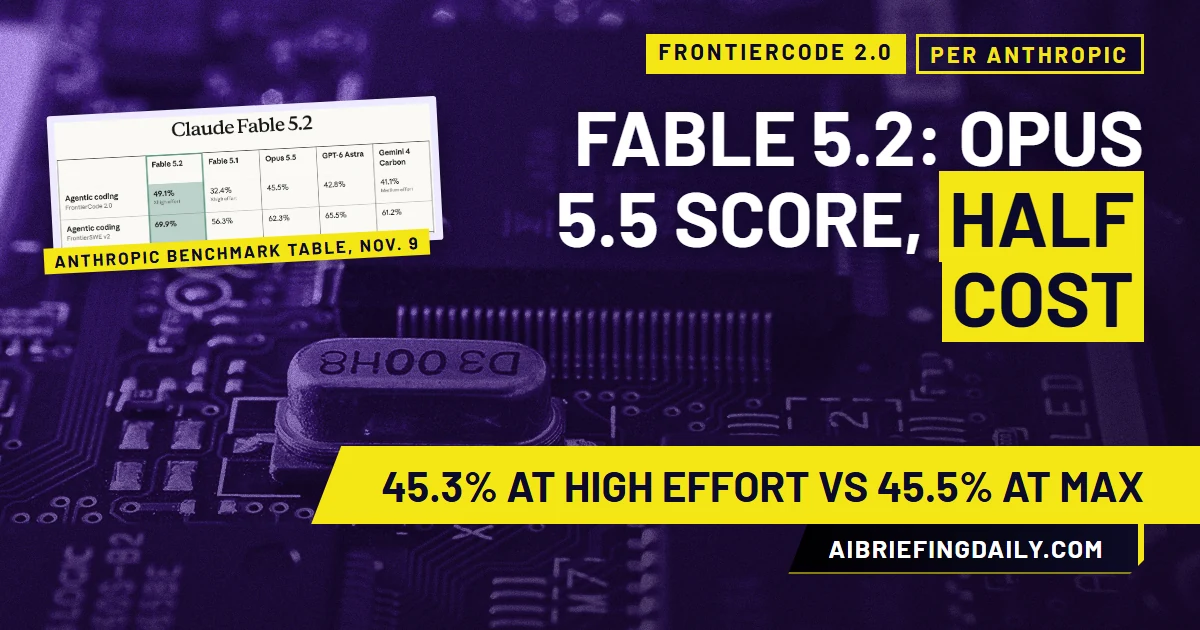
- On FrontierCode 2.0, Fable 5.2 at High effort scores 45.3% against Opus 5.5's best 45.5%, at roughly half the cost per task
- Opus 5.5 still leads on the AA-Briefcase Elo score, and Gemini 4 Carbon leads on AutomationBench
- Nearly every number comes from Anthropic's own table, and its cross-lab cybersecurity row compares different task sets
Fable 5.1 cost $10 per million input tokens. Fable 5.2 costs $8. On Monday, Nov. 9, 2026, Anthropic released Claude Fable 5.2 and Claude Mythos 5.2, and the lower price comes attached to what the company calls its strongest models for "daunting technical challenges."
Claude's launch post on X, Nov. 9, 2026, with the 18-second announcement video (@claudeai)
The first post in the @claudeai thread says the models improve in coding, reasoning and vision. The replies name three outside groups that tested them before release (the UK AI Security Institute, Frontier Design and METR) and say the models generate output up to 30% faster than Fable 5.1 and Mythos 5.1. The benchmark table is in the third reply. We read the full announcement and the Fable product page.
Fable and Mythos are one model with two sets of guardrails. Fable 5.2 carries cybersecurity and biology safeguards and is open to all users; Mythos 5.2 goes to organizations approved through Anthropic's Cyber and Life Sciences Verification Programs. For most coding and knowledge work, Anthropic still recommends Claude Opus 5.5 as the daily driver.
Price, platforms and the launch promotion
The API name is claude-fable-5-2. The announcement says it's available "on all platforms, including Amazon Web Services, Google Cloud, and Microsoft Azure." The product page names Amazon Web Services, Google Cloud and Microsoft Foundry. We didn't see Amazon Bedrock named on either page, so check your cloud console before planning around it.
Standard pricing is $8 per million input tokens and $40 per million output, "down from $10 and $50 for Fable 5.1," per the product page. That's 20% off on both sides (our math: 8 ÷ 10 and 40 ÷ 50), and CNBC reports the same figure. Fast mode, up to 2.5 times faster, costs $16 and $80, double the standard rate. In the Claude apps, eligible plans get one to three "Fable resets" this week, and Medium effort is the default there and in Claude Code.
The scoreboard, with the footnotes attached
Anthropic's table sets Fable 5.2 against Fable 5.1, Opus 5.5, OpenAI's GPT-6 Astra and Google's Gemini 4 Carbon. These are the cleanest rows, as printed:
| Benchmark | Fable 5.2 | Fable 5.1 | Opus 5.5 | GPT-6 Astra | Gemini 4 Carbon |
|---|---|---|---|---|---|
| FrontierCode 2.0 (Fable at Xhigh) | 49.1% | 32.4% | 45.5% | 42.8% | 41.1% |
| FrontierSWE v2 | 69.9% | 56.3% | 62.3% | 65.5% | 61.2% |
| AutomationBench | 51.4% | 31.4% | 42.5% | 41.4% | 53.9% |
| OSWorld 2.1 (offline, partial) | 89.3% | 83.5% | 87.2% | 79.5% | 81.5% |
| Remote Labor Index (High) | 41.3% | 17.9% | 21.3% | 20.8% | n/a |
| Humanity's Last Exam, tools | 74.2% | 65.6% | 67.7% | 57.2% | n/a |
| RoboDojo Sim (internal run) | 64.9% | 27.6% | 39.4% | 29.8% | n/a |
Our arithmetic: on FrontierCode 2.0 the new model sits 16.7 points above Fable 5.1 and 3.6 above Opus 5.5. On the Remote Labor Index, 41.3 against Opus 5.5's 21.3 is about 1.9 times. On RoboDojo, which tests control of a simulated two-arm robot from camera images, 64.9% is about 2.2 times GPT-6 Astra's 29.8%.
That last gap needs a caution from our own reporting. In the uni-robot-agent paper, GPT-6 Astra scored 28.97 in one harness and 51.90 in another, so the scaffolding around a robot model can move a score by more than 20 points. Anthropic says it ran rivals on the same harness and labels the row an internal run. That's fair inside Anthropic's setup, not a final ranking.
Half the cost, if you pick the right dial
The practical claim is about cost, and the fourth post carries it.
Claude on X, Nov. 9, 2026: the FrontierCode 2.0 cost-per-task claim and the effort default (@claudeai)
Fable 5.2 at High effort scored about level with Opus 5.5 at Max effort on FrontierCode 2.0 "for roughly half the cost per task," the post says, and at Xhigh it scored the highest of any released model Anthropic has tested. The announcement gives the numbers: 45.3% against 45.5%, with GPT-6 Astra's best at 42.8%. FrontierCode measures whether a model's code changes would be merged by the maintainers of open-source repositories.
Similar claims follow. On Perplexity's WANDR agentic-search test, Medium effort matches Opus 5.5's top score for about 40% of the cost. On Humanity's Last Exam, Low effort matches it for under a tenth of the cost.
Our reading: the story isn't that Fable 5.2 wins everywhere. A model priced at twice Opus 5.5's per-token rate (OfficeChai lists Opus 5.5 at $4 and $20, a figure we couldn't confirm on Anthropic's pages) can still finish a task for less money if it needs fewer tokens at a lower setting. Those cost curves come from "early testing" by Anthropic, so the number to trust is the one you measure.
Where Fable 5.2 doesn't lead
Gemini 4 Carbon's 53.9% on AutomationBench beats Fable 5.2's 51.4%. On the AA-Briefcase knowledge-work test, Fable 5.2 leads on the rubric (66.1% to 61.2% for Opus 5.5), but Opus 5.5 holds the higher Elo, 1800 to 1785. On Chartography, Fable 5.2's 73.4% at top effort edges Gemini's 72.5%, yet at the Medium setting Anthropic highlights (66.4%), both GPT-6 Astra (71.0%) and Gemini are ahead.
Anthropic's own wording is that the models are "a step above Opus 5.5 in almost all the capabilities we evaluated." The word "almost" does real work.
Update, Nov. 9, 2026: Meta also launched a small model today, Muse Ember, and compares it with Claude Haiku 5.5 on cost per task; our look at Muse Ember's pricing and benchmarks against Claude Haiku 5.5 shows Haiku ahead on FrontierCode 2.0-AA, 34.9% to 27.2%.
Mythos 5.2 and the cyber rows
Anthropic calls Mythos 5.2 its most capable model for cybersecurity engineering. On CVE Rediscovery, an internal test that gives a model a project snapshot from before a known vulnerability was fixed, it scores 89.6%, against 81.3% for Opus 5.5 without safeguards and 78.3% for Mythos 5.1. Anthropic words that as 10.2% more vulnerabilities than Opus 5.5 and 14.4% more than Mythos 5.1, which matches our division of the table (89.6 ÷ 81.3 and 89.6 ÷ 78.3). The October 2026 run covered 1,829 CVEs. Mozilla's Brian Grinstead says Mythos 5.2 "roughly doubled the vulnerability discovery metrics of Mythos 5.1" in their scanning campaigns.
The row to read slowly is CyScenarioBench: Mythos 5.2 at 76.3%, "GPT-6 Cyber" at 61%. A footnote says each lab's scores use "unique tasks," so those percentages come from different problems. We covered OpenAI's side in our report on GPT-6 Cyber's Firefox and Linux numbers, where every figure also came from the vendor. Another footnote cuts the other way: on Anthropic's own evaluations, it says, vulnerability identification is "roughly on par with Opus 5.5."
Fable 5.2's classifiers still block most penetration-testing and exploit-generation tasks and most research biology, with blocked queries answered by Opus 4.8 (cyber) or Opus 5 (biology). Anthropic reports about 55% fewer blocks than Fable 5.1.
Fermat's theorem and other long runs
A team of 1,000 Fable 5.2 agents formalized the proof of Fermat's Last Theorem in the Lean language in 30 hours. Anthropic's first formalization took 11 days, so this is about 8.8 times faster (our math: 264 hours ÷ 30). With the same setup, Opus 5.5 reached 26% after 18 hours. Anthropic also describes a prototype operating system built by over 1,000 subagents in eight days, a Python-to-Rust service migration that "starts about 26 times faster," and three working electronic devices built with the circuit-board maker Diode. These are Anthropic's accounts, and we haven't read the linked preprints.
What Anthropic says about safety, and what it admits
Anthropic says it believes "high-stakes risks from misalignment remain low." On its behavioral audit of about 1,900 scenarios, Mythos 5.2 scored 2.67 (lower is better), against 2.79 for Opus 5.5 and 3.28 for Mythos 5.1. In a sandbox-escape test of over 1,800 scenarios, it used planted credentials or files in 3.1% of them, level with Opus 5.5 (3.3%) and far below Mythos 5 and 5.1 (39% and 21%).
The caveat is Anthropic's own: both models say they suspect they're being evaluated "more often than any of our recent models," which clouds how they'd act in real use. A footnote adds that the UK AI Security Institute, Frontier Design and METR didn't review the post or the system card. We couldn't open the system card PDF, so its details, including any risk-level classification, are unverified here.
Anthropic also says it limited AI-R&D gains during training, so kernel-optimization and LLM-architecture skills sit at about Opus 5.5's level. For context on why that line exists, see METR's report on Anthropic's AI R&D speed-up.
The IPO clock behind the launch
CNBC reports this is Anthropic's first frontier release since Dario Amodei called for slowing AI development, and quotes Dianne Penn, head of product management for research: "We called for pacing, not pausing." The same story says an IPO could come as soon as next week, at a target valuation of $1 trillion to $1.5 trillion, down from a floated $2 trillion.
Run one hard task at High effort
On the API, take a hard task you already run on Opus 5.5 at its top setting, run it on claude-fable-5-2 at High, and compare accepted results per dollar, not benchmark points. In the apps, remember Medium is the default, and Anthropic's best numbers came from High, Xhigh or Max.
The open question is replication: Anthropic hasn't said who ran the 49.1% FrontierCode score beyond its own table.
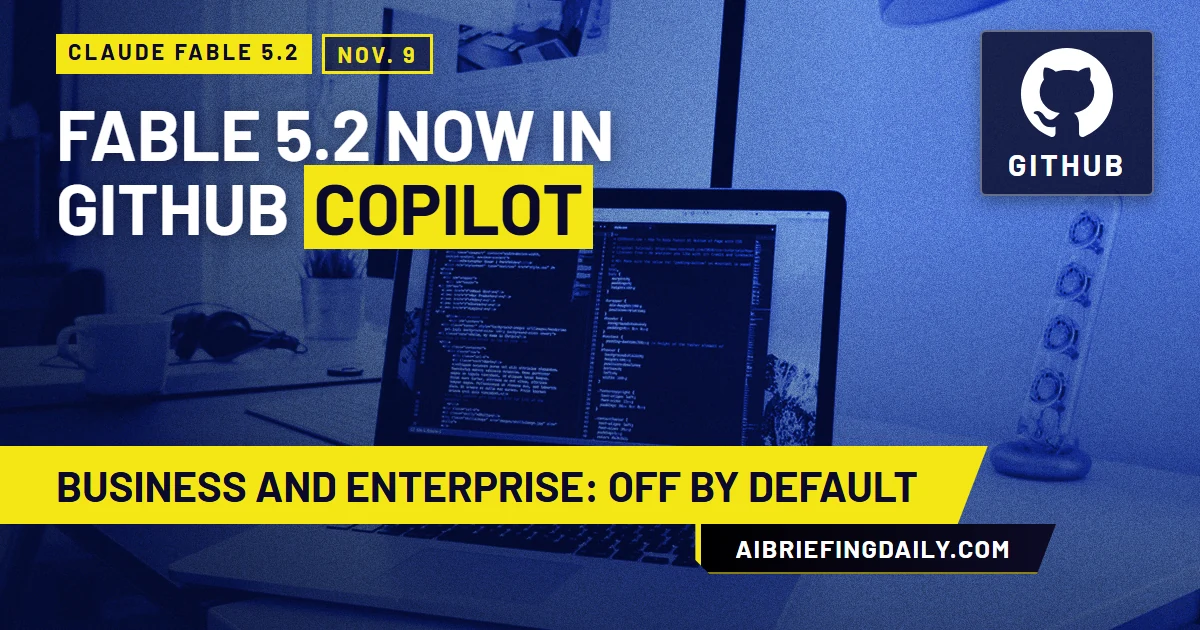
Update, Nov. 9, 2026: GitHub made Fable 5.2 generally available in Copilot, where Business and Enterprise admins must switch on a policy that accepts Anthropic's data retention; our report on Claude Fable 5.2 in GitHub Copilot, its admin opt-in and Copilot pricing has the rates and the year-end deadline for zero data retention.
Source: Anthropic, Introducing Claude Fable 5.2 and Claude Mythos 5.2
Latest
- 01Anthropic IPO: $70-$80 Price Range Pulled at RoadshowBusiness · 2026-11-10
- 02Project Zenith on AMD Ryzen AI Halo: Windows 11 Dev PCProducts · 2026-11-10
- 03Nvidia Class Action Over Huang Disclosures: What It SaysBusiness · 2026-11-10
- 04Claude Fable 5.2 in GitHub Copilot: Admin Opt-In, PricingProducts · 2026-11-10
- 05Jensen Huang and Megaspeed: The Full Timeline, Claim by ClaimBusiness · 2026-11-09