Fireworks Ultrafast: 1,500 What? Europe Capacity Waits for 2027
Fireworks Ultrafast claims "speeds exceeding 1,500" with no unit in the release; new European Nvidia capacity starts in 2027. What ships now, what waits.
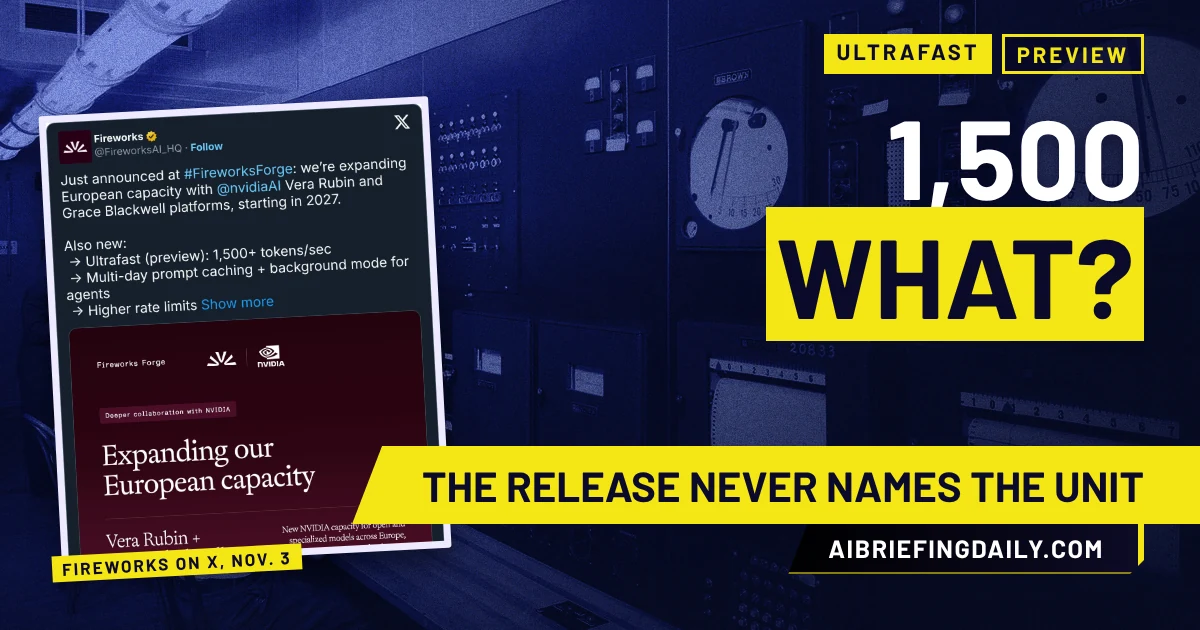
Fireworks put five announcements into one press release on Nov. 3, and only one of them is something you can use today. The company said at its first Fireworks Forge conference that it will add European capacity on Nvidia's Vera Rubin and Grace Blackwell platforms, and that the new capacity "will support deployments across Europe beginning in 2027." The rest, a fast-inference preview called Fireworks Ultrafast, multi-day prompt caching, a background mode and higher rate limits, is a different kind of news, and the release blurs the two.
Fireworks' post on X, Nov. 3, 2026, summarizing the Forge announcements (@FireworksAI_HQ)
The post is shorter than the release and says one thing the release doesn't. It lists "Ultrafast (preview): 1,500+ tokens/sec," where the press release says only that Ultrafast achieves "inference speeds exceeding 1,500." No unit, no model.
The 1,500 has a unit, and still no context
Fireworks calls Ultrafast "now in public preview on the NVIDIA Blackwell Platform" and says it combines "faster model computation with efficient communication across GPUs." That's the whole technical description in the release.
So the unit is tokens per second, which fills the first gap. The rest stays open:
- Which model. The release names none, and the post names none.
- Per user or in total. One reply streaming at 1,500 tokens a second is a latency story. A GPU cluster producing 1,500 tokens a second across all its users is a throughput story, and an ordinary one. Our reading: the release's pitch is "interactive applications that need immediate responses," which points at the first, but neither document says so.
- How it was measured. Prompt length, batch size, output length and precision are all missing.
Until Fireworks publishes a model list and a method, treat 1,500 as a vendor's best case in a preview. If you want to test it, measure time to first token and tokens per second on your own prompts, and compare with the serverless speed you get now.
"Multi-day" caching is the claim to read twice
The release says multi-day prompt caching "reduces the cost of reusing large amounts of shared context across repeated model calls." Fireworks' current prompt caching guide describes something shorter: cached prompts "usually stay in the cache for at least several minutes," and "depending on the model, load level, and deployment configuration, it can be up to several hours." On serverless models the guide gives a default discount of 50% on cached tokens, which "varies by model."
The same guide says caching "only works within 1 replica" and asks developers to send a user or session identifier, in the user field or an x-session-affinity header, so related requests land together.
So moving from hours to days is a real change for agents that keep one long context alive. Fireworks hasn't said, as far as we can find, how long "multi-day" is, whether the cache survives scaling and restarts, what the price is, or whether session affinity still decides the hit rate. Background mode has the same gap: the release says it "dramatically lowers inference costs for work that can run without an immediate response," with no discount, queue time or limit given.
Europe: two different clocks
The capacity headline mixes two things, and the dates differ.
On Oct. 29, five days before Forge, Fireworks and the UK data center operator Era4 announced a multi-year deal. According to Insurance Edge's report, Fireworks contracted Era4's whole Chesterfield site in Derbyshire: 5 MW of direct liquid-cooled capacity with Nvidia Blackwell Ultra HGX B300 GPUs. The same report says Fireworks already has deployment regions in Germany and Iceland, and that the UK deal is aimed at banks, insurers and other regulated businesses.
The Nov. 3 release is the Nvidia deal, and it points at 2027. It doesn't mention Era4 or Chesterfield, and it doesn't say whether that site is part of the new expansion or separate from it.
There's also a number the release doesn't contain. The Register's Forge coverage says Fireworks "just received an infusion of 25,000 Nvidia GPUs to support its expansion in Europe." We couldn't find that count in Fireworks' release or post, so treat it as one outlet's figure until Fireworks confirms it.
What to do with it this week
If you're a European team shopping for in-region inference, the news today is the older one: UK and German capacity exists, and Vera Rubin capacity doesn't, by Fireworks' own date. Don't plan a migration around a 2027 promise.
If you run agents with a big shared prefix, the useful test is cheap. Send the same 100,000-token context twice, an hour apart and then a day apart, and look at the cached-token counts in the responses. That tells you what "multi-day" means for your account faster than the next press release will.
One line from the Register's report explains the push behind all of it. Fireworks CEO Lin Qiao told the Forge crowd, "Cost is out of control." The release answers with caching, background work and more capacity. What it leaves out is the pricing that would show how much cheaper any of it is.
Source: Fireworks, Fireworks expands European capacity with NVIDIA Vera Rubin and Grace Blackwell platforms
Latest
- 01AMD Q3 2026 Earnings: Data Center Was More Than All the GrowthBusiness · 2026-11-04
- 02Linux TCP Flaw CVE-2026-98432: Ubuntu's Fix Is Still Opt-InWorld · 2026-11-04
- 03Microsoft: Fake Installers Rent Out Your PC in Three WaysWorld · 2026-11-04
- 04Vercel Security Review: What a Per-Push Scan Covers and CostsProducts · 2026-11-04
- 05FlashProve: What Anthropic's Provable Inference Speed MeasuresWorld · 2026-11-03