Nokia Network Traffic Report 2026: AI Hits 44% by 2035
Nokia's 2026 network traffic report projects 3,789 EB a month by 2035, 44% of it AI. Most agent traffic stays in the cloud, and the scope has limits.
Almost half of the data crossing the world's networks in 2035 will be driven by AI, according to the Nokia network traffic report published this week. The headline numbers are 3,789 exabytes (EB) a month, nearly four times what Nokia models for 2026, and 44% of it from AI. The detail inside the 46-page report changes what those numbers mean.
Nokia, the telecom-equipment maker, publishes this forecast every year to help carriers and cloud providers plan network spending. Its post on X puts the finding in one line.
Nokia on its Global Network Traffic Report, Nov. 4, 2026 (@nokia)
What the 44% is made of
Nokia splits 2035 traffic three ways: 2,108 EB a month of non-AI traffic, 987 EB of "AI-native" traffic and 694 EB of "AI-influenced" traffic. The AI-native category is traffic "generated by, driven by or dynamically managed through AI," and it's 26% of the total. The AI-influenced slice, 18%, is extra consumption prompted by AI, such as recommendations. The 44% is those two added together (1,681 of 3,789 EB, by our arithmetic).
So "44% of traffic is AI" is not "44% is chatbots." Roughly 4 of every 10 AI bytes in the forecast are influenced traffic rather than traffic from AI applications themselves.
Agent traffic that no one sees
Nokia projects agentic AI traffic to reach 585 EB a month, 160 times its 2026 level, growing at 76% a year from a small base. The report's more interesting claim is where it flows: 462 EB of that, about 79% by our math, is cloud traffic that "will originate inside the network," between orchestrators, tools and data sources. Only 123 EB crosses the access network to users and devices.
That matches the executive summary's line that "the majority of AI traffic will be invisible to end users, remaining within the confines of the cloud." For anyone building agents, the report's logic is that one user request fans out into many service-to-service exchanges, and each tool call or retrieval step adds to network load that the user never sees.
How one request becomes a cascade
Nokia is specific about what counts as "agentic." An interaction is agentic "when the orchestrator selects and triggers that interaction based on an earlier result," so a single model call to a tool doesn't qualify. Its example workflow has an orchestrator that sends a task to a planning agent, hands steps to execution agents, pulls from memory, retrieval and databases, and passes the result to a QA agent, repeating the loop as needed. "A single request fans out into multiple service-to-service exchanges," the report says.
The network sees more than the user does. Nokia counts 1,134 EB a month of AI traffic crossing the access network in 2035, but once each exchange is counted on every link it travels, the network carries 3,720 EB a month, 3.3 times as much, and more than 70% of it runs on carrier transport links.
Agent sessions also look different from chat. The report says agentic tasks "exhibit longer sessions of traffic exchanges as AI agents plan, call tools and report progress," and that the link "rarely remains idle for extended periods." In its chart of session bytes, agentic text is 62% uplink and 38% downlink, against 32% and 68% for ordinary GenAI text.
Robots upload, they don't download
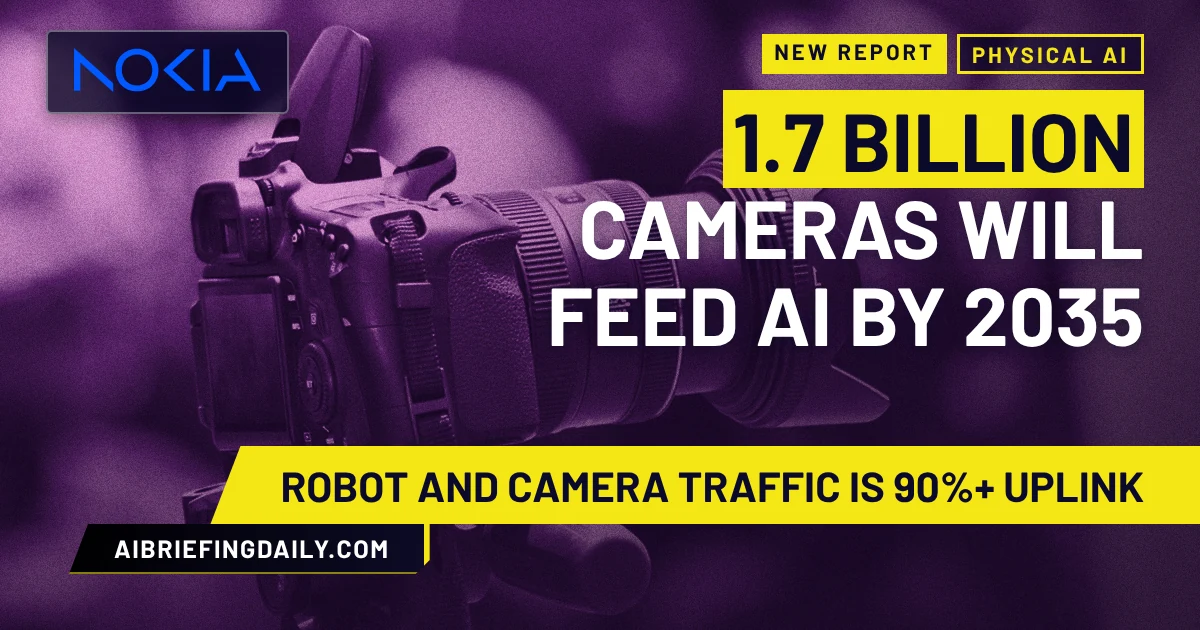
Physical AI, meaning cameras, robots, vehicles and drones, is a smaller number: about 67 EB a month in 2035, 105 times 2026, or about 2% of the total by our arithmetic. Its shape is the point. More than 90% of that traffic goes up from device to cloud, because machines stream camera and sensor feeds rather than receive video.
Nokia's installed-base estimates for 2035 are approximately 1.7 billion cameras (surveillance, monitoring, number-plate recognition and body-worn), 17.1 million humanoid robots, 6.8 million commercial drones and 2.5 million robotaxis. For cells with the heaviest AI use, uplink reaches 24% of access traffic, a 1:3 upload-to-download ratio. Nokia's own examples of upload-heavy services include GenAI voice conversations, at 90% uplink, and smart glasses streaming video, at 3-to-1 uplink to downlink.
A third of AI processing moves to the edge
By 2035, Nokia expects the edge and metro core to serve 36% of AI-native traffic, which it calls the "AI grid." The report ties the move to more efficient models, lower latency and data sovereignty. The routing of this traffic, not just its volume, is the planning question for operators.
What the report leaves out
The scope matters as much as the totals. Nokia's model counts AI traffic that crosses the access network or moves between cloud services in AI workflows. It leaves out traffic that stays on a device or on premises, plus web crawling to collect training data, transfers of training datasets between data centers, token traffic inside AI-training fabrics, and replication and backup between data centers. Processing inside an AI platform, such as GPU-to-GPU communication, isn't counted either. So 44% is not a share of all AI computing.
Two other cautions come from the document itself. The access-network forecasts are given under conservative, moderate and aggressive scenarios: global access traffic grows 3x to 5x, to between 2,498 and 4,657 EB a month, with 3,242 in the moderate case. The pages we read don't say which scenario the 3,789 headline uses, so treat it as a single point from a range. And all of it is Nokia's modeled projection, not a measurement of live networks. Nokia sells the equipment those networks run on, which doesn't make the forecast wrong, and it does explain the emphasis on uplink, edge and transport.
One number to check against your own logs
If you operate an agent platform, the report suggests a test: count the internal calls one user request creates, and compare that to the bytes that reach the user. Nokia's forecast says that ratio is where most of AI's network traffic will sit, and your own logs can show whether it's true at your scale.
Source: Nokia
Latest
- 01ChatGPT Voice Now Works in Finances: What to KnowProducts · 2026-11-04
- 02NVIDIA Physical AI Agent Bootcamp: 2 of 4 Courses Are LiveProducts · 2026-11-04
- 03OpenAI Security Warnings: What Reuters Reported and What ChangedWorld · 2026-11-04
- 04CrowdStrike Buys Fiddler and Dreadnode: Two Deals, No PriceBusiness · 2026-11-04
- 05Crouton Alpha: Free Stealth Model, 1M Context, 30-Day LogsModels · 2026-11-04