Nvidia Board Scrutiny and a Blacklisted School's H200 Buy
Two Reuters reports hit Nvidia on Nov. 11. Four of its 11 directors date to the 1990s, and a PLA-linked university bought two H200 chips via a reseller.
Two Reuters posts went out within two hours of each other on Wednesday, Nov. 11, 2026, and they come at Nvidia from opposite ends. At 6:45 a.m. ET, Reuters Business said a Chinese university tied to the People's Liberation Army had bought Nvidia's H200 chips while sitting on a U.S. export blacklist. At 8:20 a.m., Reuters promoted a segment on Nvidia board scrutiny, meaning who is investigating CEO Jensen Huang: Nvidia's own board, and whether it's independent enough for the job.
Neither story says Nvidia sold chips to a blacklisted buyer, and neither says the board has failed at anything. One is a guest's concern about the board; the other is a reporting finding about a reseller. Put together, they show where the pressure on the company is building.
Four directors who were in the room in the 1990s
The first post, from the main Reuters account, reads: "Nvidia's board is under the microscope as it investigates CEO Jensen Huang." It quotes Ross Kerber on Reuters World News, in an episode dated Nov. 11: "Three or four of them go back to the 1990s ... and there's a real concern ... that this is sort of his clubby group of insiders."
Reuters' Nov. 11 post on Nvidia's board and the Huang investigation (@Reuters)
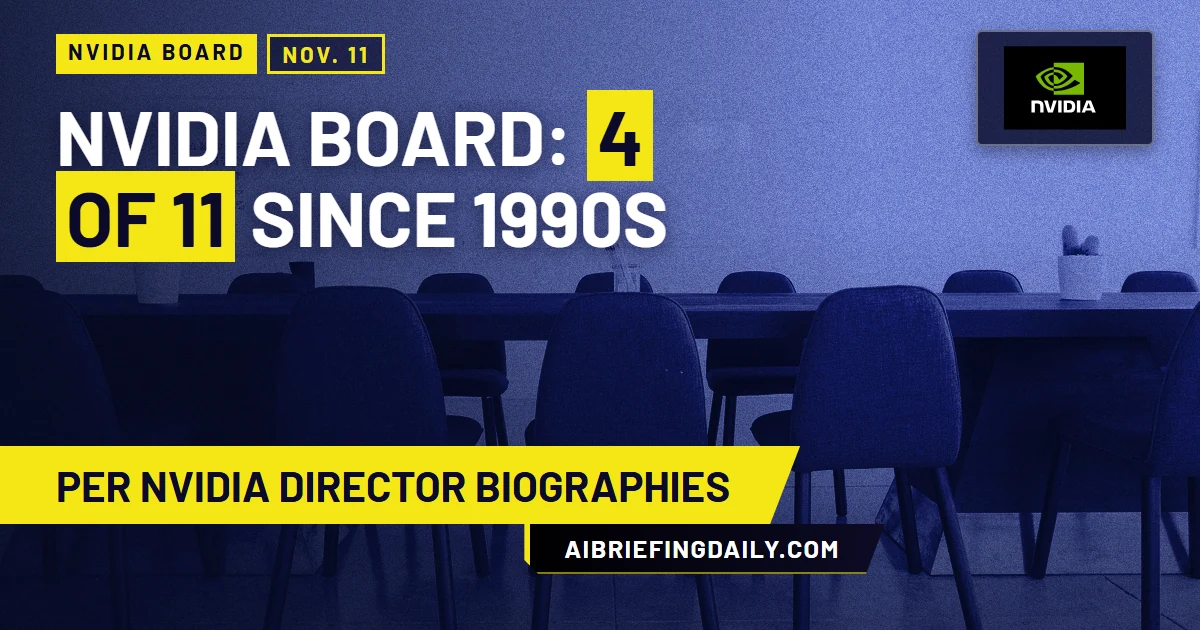
That's a concern voiced by a guest, not a finding. It's also checkable. On Nvidia's board page, the biographies of the 11 directors give these start dates: Tench Coxe, 1993; Harvey Jones, 1993; Brooke Seawell, 1997; and Mark Stevens, who served from 1993 to 2006 and returned in 2008. That makes four of 11, or 36%, which fits Kerber's "three or four." Huang, who founded the company in 1993 and has been on the board since, brings the count of people with a 1990s tie to five of 11.
Tenure also lines up with committee seats. Seawell chairs the audit committee, and Coxe and Jones sit on it, according to their bios. The newer arrivals include Dawn Hudson (2013), Stephen Neal (March 2019), John Dabiri (2020) and Melissa Lora (2023). Neal is the lead independent director and chairs the nominating and governance committee, so the person with the formal independence role is a 2019 arrival, not a founder-era one.
What the board's statement leaves open
We went through the wording of the Nov. 8 board statement in our first report on the probe. It says "a committee of independent directors, assisted by outside independent counsel, will oversee the investigation." It doesn't say who is on that committee. On Nov. 10 the board said it had retained Joon H. Kim, a former acting U.S. attorney for the Southern District of New York, and his firm Wachtell, Lipton, Rosen & Katz, CNBC reported.
Long service cuts both ways. Directors who have watched the company since its first decade know it better than anyone, and they also have the longest history with its CEO. Our reading is that the outside counsel answers part of Kerber's worry, because the lawyers don't owe Huang anything. The committee roster answers the rest, and it's one disclosure away.
Two H200 chips, one reseller
The second post, from Reuters Business, summarizes an exclusive by Eduardo Baptista, datelined Beijing: "A Chinese university linked to the People's Liberation Army bought Nvidia's powerful H200 AI chips despite being on a US export blacklist, exposing gaps in Washington's efforts to restrict China's access to advanced technology."
Reuters Business' Nov. 11 post on the H200 purchase (@ReutersBiz)
The full Reuters report names Northwestern Polytechnical University, a member of China's "Seven Sons of National Defense" group. An Oct. 21 procurement record on its website shows the management school bought two H200 chips for 874,700 yuan ($123,000) from Shaanxi Bosuan Network Technology, "rather than directly from Nvidia." The Commerce Department put the university on the Entity List in 2001 and tightened the rules in 2019, so licenses are denied in most cases.
The chips weren't the only route. Reuters says the university also bought access this year through five contracts for rented computing capacity. Two of them, signed in January by its cybersecurity school, ran seven months each and covered servers with eight H200 chips apiece, for 441,700 and 441,000 yuan, for fine-tuning and reinforcement-learning training. A Reuters review of 26 Chinese procurement and corporate records found other institutions doing the same with restricted chips: Shenzhen University bought three H100s for 769,800 yuan in September, and Beihang University bought four A800s for 489,000 yuan in April.
What the prices show
Our arithmetic, from Reuters' figures: $123,000 for two chips implies about $61,500 per H200. The two rental contracts together cost 882,700 yuan for up to 16 chips over seven months, roughly 55,200 yuan per chip, against 437,350 yuan per purchased chip. Renting was about one-eighth the cost per chip. It isn't a like-for-like comparison, since a purchase is permanent and a lease ends, but it shows why a ban on buying pushes demand toward renting.
Rentals also sit squarely on the rule Reuters flags. The U.S. began allowing some H200 exports to China case by case in January, but that didn't lift the Entity List limits, and the January rules require safeguards against blacklisted entities reaching the chips remotely. Reuters says the records say little about where the processors came from or where the rented servers operate. Nvidia, the Commerce Department's Bureau of Industry and Security and the university didn't respond to its requests for comment, and Reuters couldn't find contact details for the supplier.
Where the two stories meet
Reuters ties the findings to Huang's lobbying. He has argued that continued U.S. sales to China preserve American technological leadership and keep Chinese customers dependent on U.S. technology, while some lawmakers say the most powerful chips can speed Chinese weapons design and military modernization. CNBC reported that Nvidia and its board face pressure over what the company knew about restricted chip sales to Chinese companies.
The board's investigation is narrow by design. It asks whether Huang was targeted by a foreign intelligence effort and whether secrets or national security were compromised. It doesn't mention chip sales. The Northwestern Polytechnical records ask something else: how a licensing denial plays out once a reseller or a rental contract sits in between. Both questions were already on the table. Analysts called the probe a governance risk in our roundup of Wall Street's reaction, and a shareholder suit now targets Huang's earlier statements about Megaspeed, as we laid out in our look at the class action. The chip purchases behind the Megaspeed matter are in our timeline.
Two disclosures that would settle most of it
Nvidia reports third-quarter earnings on Nov. 17, and three House chairs want Huang for a closed-door briefing on Nov. 18. Two small disclosures would answer a lot before either date: the names of the independent directors on the investigating committee, and a statement from Nvidia on whether it sells to, or supports, resellers who serve Entity List institutions. If neither appears, the earnings call is the first place an analyst can ask. Today, Nov. 11, is also the date the chairmen set for Huang to accept the briefing or propose another day, as we reported from the committee's letter.
Source: Reuters, PLA-linked Chinese university bought Nvidia H200 chips despite US blacklist
Latest
- 01Anthropic's IPO debut rests on Google and Broadcom backstopsBusiness · 2026-11-15
- 02AMD's Lisa Su is named CEO of the Year as Nvidia's CEO walks outBusiness · 2026-11-13
- 03Jensen Huang resigns as Nvidia CEO, Colette Kress named interimBusiness · 2026-11-13
- 04ChatGPT Finances comes to the desktop app for users in the USProducts · 2026-11-12
- 05Nvidia board prepares to oust CEO Jensen Huang, WSJ reportsBusiness · 2026-11-12