China AI Employment Guidelines: 18 Tasks to Soften Job Loss
China AI employment guidelines set 18 tasks in six areas, from job-risk checks to a layoff buffer period. What the State Council text does and doesn't say
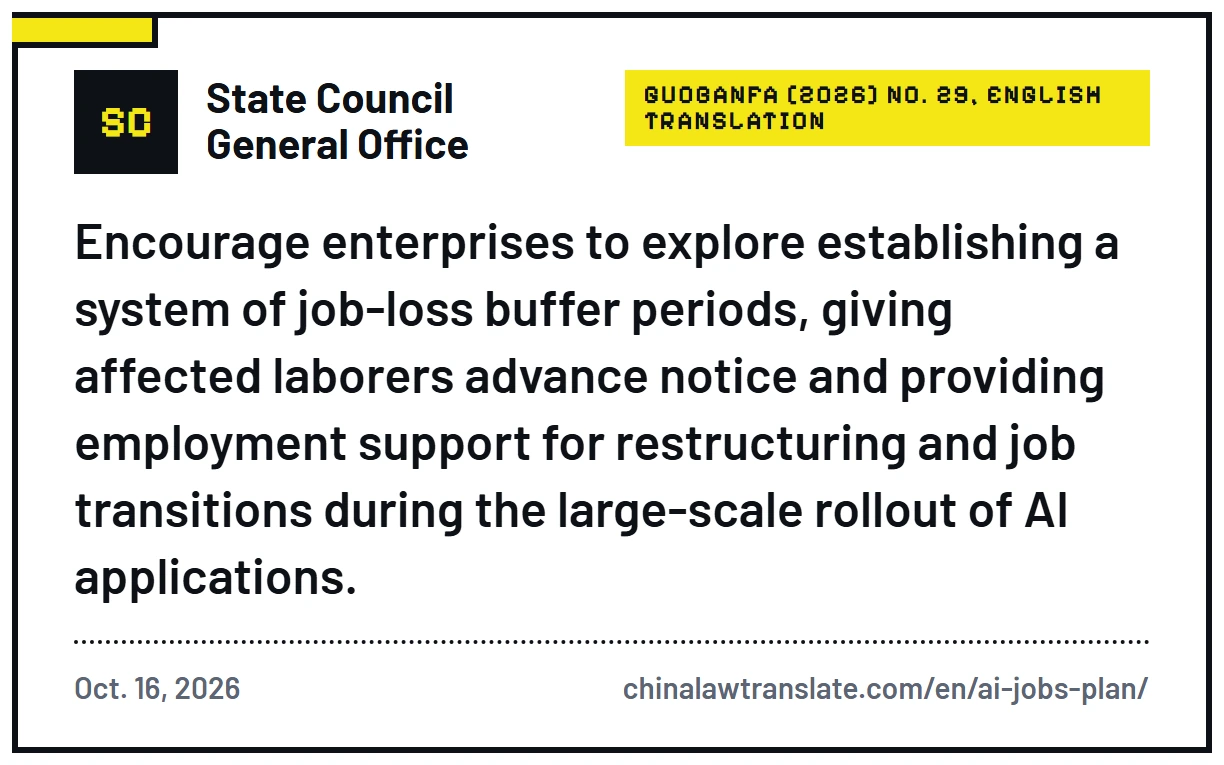
One sentence in China's new AI employment guidelines carries more weight than it first seems. When companies roll out AI on a large scale, the text says, they are encouraged to explore job-loss buffer periods: tell affected workers early and help them move to new roles. Encouraged. Explore. Not required.
That sentence sits inside Guobanfa [2026] No. 29, a policy opinion from the General Office of the State Council, China's cabinet. It is dated Oct. 16, 2026. In a report carried by Allwork.Space, Reuters said the guidelines were issued on Friday, Oct. 23. China Law Translate published an English translation on Oct. 26, and the Chinese original is posted on the Ministry of Ecology and Environment's site, stamped Oct. 24. The English title reads "Opinions on Adapting to the Development of Artificial Intelligence Technology to Help Build an Employment-Friendly Development Model." Every quote in this story comes from that translation.
The China AI employment guidelines list 18 tasks across six areas. It's a policy direction, not a law, and nothing in it sets a number, a deadline or a penalty.
Most of the 18 tasks are about making jobs, not saving them
Read the list top to bottom and the tone is more "build" than "protect." The first area, job creation, is four tasks. Eastern provinces are urged to develop core AI industries, while central and western regions take on upstream and downstream work such as data labeling and smart-terminal manufacturing. Qualifying firms, "AI-native" ones among them, can be included, under the rules, in a special loan program for stable hiring. A separate plan aims to help small and midsize businesses of all kinds use the open-source ecosystem, and the document calls for a "high-level" open-source AI community and for state investment funds to back AI companies "in accordance with market methods."
New job titles get their own task. The text names digital management specialists, AI engineering technicians and AI trainers as occupations to expand, and encourages local governments to add professional-title tracks and skill-level certifications for them.
Training adds two more tasks: more AI majors and "micro-majors" at universities and vocational schools, plus a retraining push under the "Skills Light Up the Future" campaign. College graduates and other young people, migrant workers and unemployed people are all named as targets.
A polite brake on labor-intensive industries
Task 6 is the one that reads like a speed limit. AI should be applied first in labor-scarce and high-risk jobs, the text says. For labor-intensive industries, authorities should "exercise caution" about the scope, intensity and pace of AI use, to minimize the impact on workers.
Then comes the buffer period. Firms are encouraged to give affected workers advance notice and offer transition support during the large-scale rollout of AI. How long a buffer, who pays for it, what counts as large-scale: none of that is defined. A company that ignores the idea faces no stated consequence.
The one real checkpoint
Task 7 is the closest thing to a gate. The document calls for a mechanism to assess the employment risk of AI applications, and to steer innovation resources toward areas with high potential for job creation.
The teeth are narrow. For AI application scenarios where market entry might have a significant impact on employment, a job-risk assessment is to be conducted alongside the normal review, and relevant departments should coordinate employment support for workers who are restructured or moved to new jobs. In other sectors, assessments are to be conducted "in consideration of actual conditions." Which sectors count as market-entry fields, and what counts as significant, the text doesn't define.
Algorithm bosses, gig workers and "intelligent agents"
The fifth area, labor rights and social security, has some of the most concrete language. First, a task from the section before it: Task 12 says workers displaced by AI should get employment assistance, including vocational guidance, skills training, job recommendations and entrepreneurship support, and that unemployment insurance benefits should be paid promptly and in full to covered workers.
Task 13 turns to how employers use AI. It calls for correcting violations such as the abuse of algorithms causing employment discrimination, false hiring and infringement of rights to privacy and rest. Task 14 encourages gig and platform workers to join the basic pension insurance for urban employees and expands pilots for occupational injury protection.
One line may interest anyone following AI agents. Task 15 says to "cultivate and develop innovative work forms such as intelligent agents," and encourages companies to invest more in public-interest AI technologies, services and open-source communities. It also calls for pay systems that fit the characteristics of AI-sector workers. The translation doesn't say whether "intelligent agents" means AI software agents or something else, or what the work looks like in practice.
Watching the numbers before layoffs show up
The last area is about instruments. Tasks 16 through 18 call for cross-agency sharing of AI-industry and employment data, regional and industry-specific monitoring models, a special investigation into how AI adoption is changing jobs and skills, and a set of AI employment research centers at universities and research institutions.
The most notable move is the last one. AI-related job risk is to be folded into China's existing mechanism for preventing and mitigating large-scale unemployment, and agencies are to coordinate the drafting of response plans. The opinion gives overall coordination to the human resources and social security departments and the development and reform departments at all levels.
All 18 tasks at a glance
Short summaries are ours. The last column lists the main verbs in the English translation, which show how firmly each task is worded.
| # | Area | What it asks for | Main verbs |
|---|---|---|---|
| 1 | Job creation | Grow AI jobs in emerging fields; eastern regions host core AI industries, central and western regions take downstream work | Encourage, guide, accelerate |
| 2 | Job creation | Help small and midsize businesses keep and add jobs with open source and low-cost digital tools | Implement, strengthen, encourage |
| 3 | Job creation | New entrepreneurship models, state investment funds, a high-level open-source community | Give play to, establish, promote |
| 4 | Job creation | New AI occupations, professional titles and skill certifications | Accelerate; regions "encouraged" |
| 5 | Upgrade paths | Human-machine collaboration in industry and farming; more service-sector jobs | Give play to, guide, accelerate |
| 6 | Upgrade paths | AI first in labor-scarce and high-risk jobs; caution in labor-intensive industries; job-loss buffer periods | Prioritize, exercise caution, encourage |
| 7 | Upgrade paths | Employment risk assessment for AI projects, run alongside review in market-entry fields | Assess; "are to be conducted" |
| 8 | Skills | More AI majors and micro-majors; school-business training | Encourage, strengthen, advance |
| 9 | Skills | AI training for graduates, migrant workers and the unemployed | Thoroughly implement, encourage |
| 10 | Policy services | Use AI to match people with employment policies | Explore, strengthen |
| 11 | Policy services | Upgrade national job platforms; AI pilot bases; AI in dispute mediation and recruiting | Upgrade, advance, promote |
| 12 | Policy services | Employment help for workers displaced by AI; unemployment insurance paid promptly and in full | Follow provisions, ensure |
| 13 | Rights and security | Protect worker rights in human-machine work; correct algorithm abuse in hiring | Strengthen, regulate, correct |
| 14 | Rights and security | Pensions for gig and new-form workers; wider injury-protection pilots | Encourage, support, expand |
| 15 | Rights and security | Pay systems for AI-sector workers; "intelligent agents" as new work forms | Guide, cultivate, encourage |
| 16 | Monitoring and response | Share data across agencies; build monitoring models | Enhance, jointly establish |
| 17 | Monitoring and response | Special investigation of AI's job effects; AI employment research centers | Carry out, establish |
| 18 | Monitoring and response | Add AI job risk to the mass-unemployment mechanism; draft response plans | Include, coordinate, strengthen |
Quick answers
Is it a law? No. It's an opinion from the State Council's General Office, addressed to provincial governments and State Council departments, and it sets no penalties.
Does it ban AI layoffs? No. Buffer periods are something companies are "encouraged to explore," and nothing in the text forbids layoffs.
Does it apply to foreign companies? The text doesn't mention them. It is addressed to government bodies, so what it means for any company depends on the rules local authorities write.
Where this leaves things
We read the 18 tasks by what each one does. Seven are about creating jobs or skills (tasks 1 to 5, 8 and 9). Two use AI to improve job services. Three cushion rights and income (13 to 15). Three build monitoring (16 to 18). Only three go straight at displacement: the labor-intensive pacing in task 6, the risk check in task 7, and the worker support in task 12. That's 3 of 18, about one in six. It's our classification, not the document's, and a reader could also count task 18.
The balance fits the opening requirement in the document, which wants to enhance AI's "positive effects" on jobs while "effectively reducing the impact of AI applications replacing jobs." It is a growth-first policy with a safety net attached, not a brake. And of the few displacement tools, only task 7 is a check built into project review, and it applies only to market-entry scenarios. The buffer period is a suggestion.
What we can't tell is how hard any of this will bite. The text gives no estimates for jobs at risk, and it leaves the key definitions open. All regions and departments are told to implement it "in light of their specific circumstances," so practice may differ a lot by province and sector.
Beijing has put AI job risk on the official books: it must be assessed, monitored and planned for. But the only hard checkpoint is narrow, and the buffer period is voluntary. What will matter is the follow-up rules that define "significant" and "market entry."
For now, treat this as a signal of direction. If you track Chinese AI deployment, watch for implementing rules from the human resources and social security departments, any list of market-entry scenarios that trigger the assessment, and the first provincial pilots of buffer-period schemes. Until those appear, the document tells you what Beijing wants to avoid, not what companies must do.
Source: General Office of the State Council (English translation by China Law Translate)
Latest
- 01Vercel Security Review: What a Per-Push Scan Covers and CostsProducts · 2026-11-04
- 02FlashProve: What Anthropic's Provable Inference Speed MeasuresWorld · 2026-11-03
- 03uni-robot-agent: What Qwen3.8-Flash-Next's 31.39 Really BeatsModels · 2026-11-03
- 04LlamaIndex OCRia-1 Inference: What the 10x Speedup MeasuresModels · 2026-11-03
- 05Google Suncatcher Gemma 4 Orbit Test: What the Haiku ProvesModels · 2026-11-03