White House Keeps AI Model Testing Framework Secret in FOIA Suit
The White House won't release its seven-page AI model testing framework. What Executive Order 14409 says, what the FOIA suit seeks and what stays unknown
The White House keeps its AI model testing framework out of public view, and the document is, by one report, just seven pages in Word. The government says it isn't classified. It still won't hand it over.
On Oct. 30, the Office of the National Cyber Director told the nonprofit Protect Democracy that it would not release the full framework, citing national security and commercial exemptions, according to The Information's reporting as summarized by Complete AI Training. According to Heise, the office released other records instead, mostly emails between the office, the Commerce Department and AI labs, showing which organizations were approved as "trusted partners." The full list is still missing.
That makes the AI model testing framework a rare case: a pre-release review system that is voluntary on paper, built by an executive order, and unreadable to everyone outside a small circle.
What the executive order puts in writing
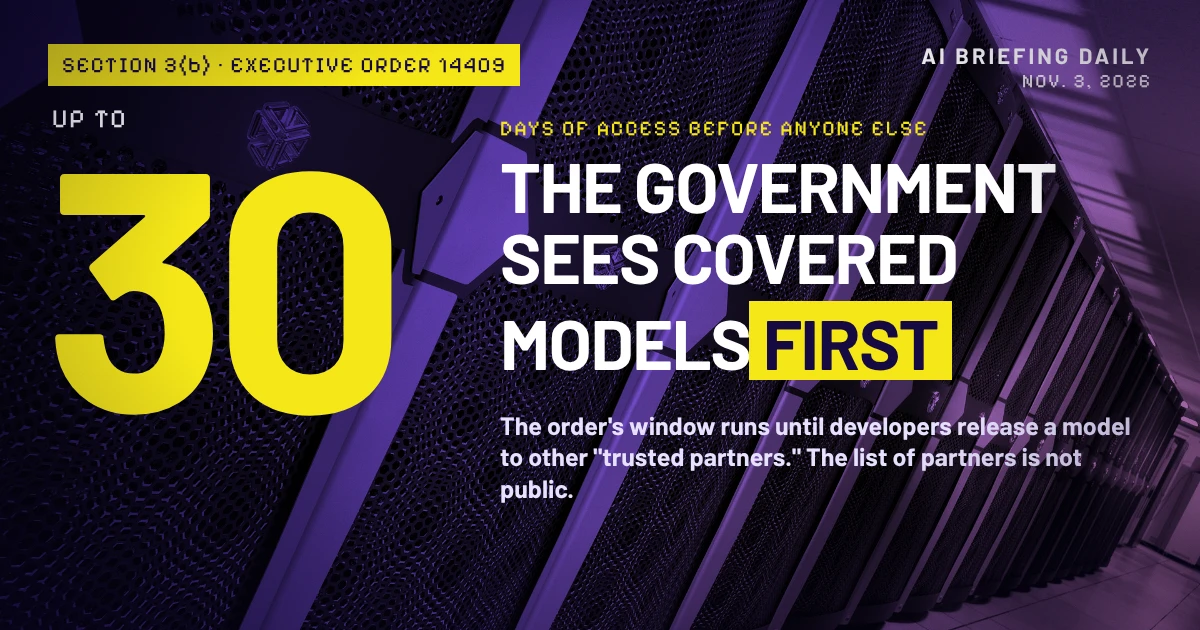
Executive Order 14409, "Promoting Advanced Artificial Intelligence Innovation and Security," was signed June 2, 2026, according to the White House text. Section 3 does three things. It orders a classified benchmarking process to assess AI models' advanced cyber capabilities and set the threshold for a "covered frontier model." It calls for a voluntary framework with AI developers. And it lets developers and the government select "trusted partners" who get early access.
One detail gets blurred in most retellings. The order says developers may give the government access to covered models for up to 30 days before they plan to release them to other trusted partners, not before public launch. The complaint in the lawsuit reads it as up to 30 days of exclusive access before a model goes to any other entity. Either way, the window is about who sees a model first, and the order gives no criteria for who counts as a trusted partner.
The order's own limit: nothing in Section 3 authorizes "a mandatory governmental licensing, preclearance, or permitting requirement" for developing or releasing AI models. Agencies had 60 days from June 2 to build the framework.
Voluntary on paper
The order says voluntary, and its text backs that up. The lawsuit argues the label isn't the whole story.
The complaint alleges that on June 12, 2026, the Commerce Department's Bureau of Industry and Security issued a directive that suspended worldwide public access to two Anthropic models, Claude Fable 5 and Claude Mythos 5, within ninety minutes, under an export-control authority never before used on an AI model. According to the complaint, access to Mythos 5 returned first only for entities the government designated as trusted partners, and the controls were lifted June 30. Those are the plaintiff's allegations, not findings.
Read together, the claim is that a voluntary framework sits next to tools that aren't voluntary. We can't say how the two connect in practice, because the framework's text is the document nobody outside the room has read.
What the suit asks the government to hand over
Protect Democracy Project, Inc. filed its complaint on Sept. 1, 2026, in the U.S. District Court for the District of Columbia, against the Office of the National Cyber Director, the Office of Science and Technology Policy, the Commerce Department's Bureau of Industry and Security and the Treasury Department. It followed FOIA requests filed Aug. 7. The complaint says the government has not specified a statutory basis for the review framework, and that the group is not asking for the classified benchmarks, only the unclassified framework text, the terms of participation, the identity of participants and the criteria for access.
An unnamed White House official, quoted in the complaint from an Axios report of Aug. 3, put the position this way: "Just because things are unclassified that doesn't mean we are going to broadcast them to everyone."
The case has moved. Protect Democracy says a first production arrived Sept. 8 in redacted form. A Sept. 15 joint status report, per The Information, narrowed the request to four items, including "substantively unredacted copies of the text," and set Oct. 30 as the production date, with an itemized index for anything withheld. The Oct. 30 letter is the result. We could not confirm whether that index was delivered.
The date that matters
The next date is a further joint status report on Nov. 13, where, according to The Information's account, the parties are to set a briefing schedule if needed. That is where a judge would start testing the national security and commercial exemptions against a document the government itself calls unclassified.
Three things are worth tracking:
- The exemptions. Which FOIA exemptions the government actually invokes, a detail no outlet we found reports.
- The partner list. Whether the court orders the names and the selection criteria out, not just the emails.
- The text itself. Seven pages is small enough that a partial release would show quickly how much of it is rules and how much is process.
If you build on frontier models, the practical question is narrower: ask your vendor whether it takes part in the program, and what that changes about when you get access to new releases.
Source: Complaint, Protect Democracy Project v. Office of the National Cyber Director (D.D.C.)
Latest
- 01Vercel Security Review: What a Per-Push Scan Covers and CostsProducts · 2026-11-04
- 02FlashProve: What Anthropic's Provable Inference Speed MeasuresWorld · 2026-11-03
- 03uni-robot-agent: What Qwen3.8-Flash-Next's 31.39 Really BeatsModels · 2026-11-03
- 04LlamaIndex OCRia-1 Inference: What the 10x Speedup MeasuresModels · 2026-11-03
- 05Google Suncatcher Gemma 4 Orbit Test: What the Haiku ProvesModels · 2026-11-03