China Basic AI Law: NDRC Promises One, With No Draft Yet
China's planner says it will speed up a basic AI law and lifecycle safety standards. What Wang Ruomeng said Nov. 3, what already exists and what is missing
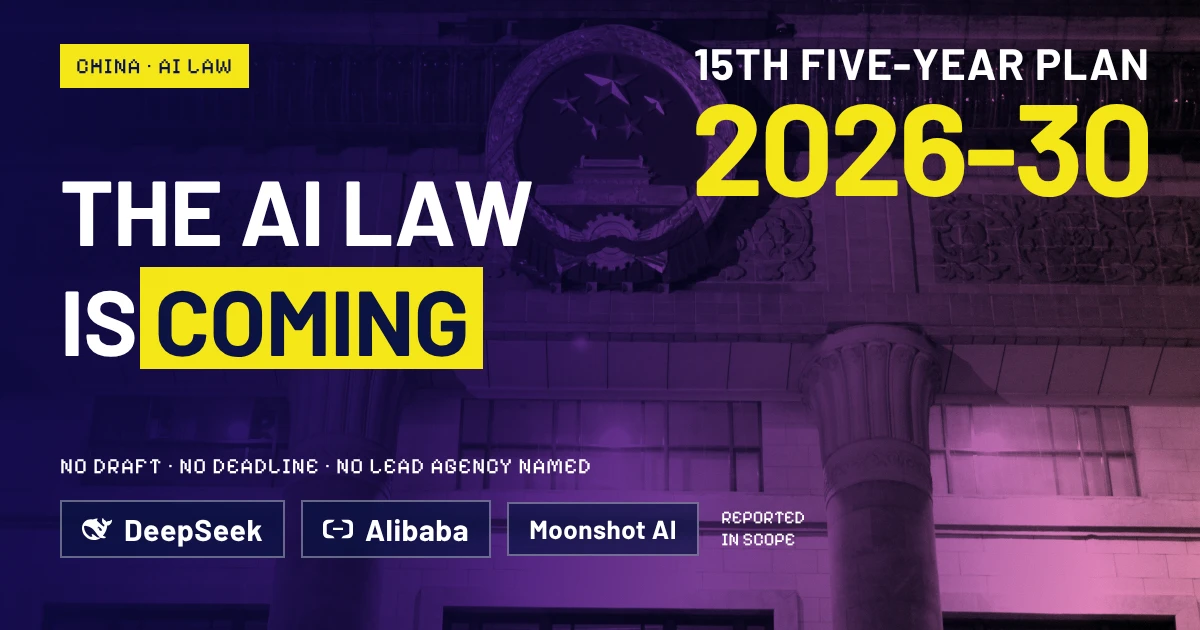
China's economic planner wants a basic AI law, and on Nov. 3 it said it would move faster. It did not say when. Speaking at the National Development and Reform Commission's "Striving for the 15th Five-Year Plan" press series, Wang Ruomeng, a deputy director-general of the NDRC's Department of Innovation and High-Tech Development, said the country will "accelerate" basic, comprehensive legislation and build safety standards that cover the whole AI lifecycle.
That is the China basic AI law story in one line: a stated priority, no draft text, no deadline and no named lead agency. This piece separates what Wang said from what other outlets added, and from what already exists on the books.
What Wang actually said
The remarks, as carried by Gelonghui on Sina Finance, open with a premise: there is now broad agreement in Chinese society that AI brings opportunities and risks together. During the 15th Five-Year Plan period (2026-2030), Wang said, China will balance development and security and build security into every link of AI research, application and governance. Four areas follow. The translations below are ours.
The first is rules. Wang said officials will systematically sum up China's AI governance experience and speed up basic, comprehensive AI legislation to build what Wang called the "four beams and eight pillars" of the AI legal system, a Chinese idiom for the main frame of a building. Separately, they will improve legislation on common elements such as data, computing power and algorithms, and on key application scenarios. On standards, the pledge reads, in our translation:
establish safety standards and ethical guidelines covering the whole AI lifecycle.
All four areas are summarized below, along with what the text we read leaves open.
| Area | What Wang promised | Left open |
|---|---|---|
| Rules | A basic, comprehensive AI law; laws on data, computing power, algorithms and key uses; lifecycle safety standards and ethics guidelines | Draft text, timeline, drafting body |
| How regulators behave | Reasonable transition periods, "transparent and predictable" requirements, sector compliance guidance, assessment, consulting and certification services | Which rules, which sectors, how long |
| Shared responsibility | Safety shared by governments, industry groups, companies and the public | Who answers for what |
| Social effects | Closer watch on AI's effect on employment; model trainers and data annotators added to the national occupational classification | Dates, thresholds |
What other outlets added, and how far to trust it
Two details in English-language coverage are not in the Sina text we read.
ChainCatcher's republication of a Beijing Daily report says the rules will be assessed periodically, that regulatory sandboxes will be supported, and that developers and operators should disclose safety risks and report incidents and vulnerabilities. Bloomberg, as relayed by Korea's SBS, adds that DeepSeek, Moonshot AI and Alibaba are expected to fall under the rules, and frames the aim as lowering the risk that increasingly powerful systems become uncontrollable.
Both are secondhand. The NDRC's own transcript wasn't posted when we checked, and Bloomberg's original sits behind access limits, so treat the "uncontrollable" framing and the company names as the reporters' reading until the full text is out.
Not a new idea, and not a draft
The headline sounds new. The commitment isn't. The State Council's 2026 legislative work plan, published May 11, says comprehensive legislation for the healthy development of AI "will be accelerated" and that laws on data, computing power, algorithms and key application scenarios will be improved. That plan, as summarized, lists no AI-specific draft and no deadline. Wang's Nov. 3 answer repeats the same list, now under the Five-Year Plan banner.
So the real news is who said it and when: the national planning agency put the AI law inside the 2026-2030 plan period. It did not say whether the result would be a national law from the legislature or a State Council regulation, and we found no public draft.
What already binds, and what is only guidance
Two pieces already exist, and they are very different in weight.
The amended Cybersecurity Law, adopted Oct. 28, 2025 and in force since Jan. 1, 2026, added an AI clause. According to Haynes Boone's analysis, Article 20 backs basic AI research, core technologies and computing and data foundations, and calls for AI ethics standards and stronger risk monitoring and safety oversight. It's a law, but a supportive one, not a rulebook for model developers.
The AI Safety Governance Framework 2.0, released Sept. 15, 2025 under the Cyberspace Administration of China's guidance, already organizes safety measures by lifecycle stage: research and development, deployment, operation and use, with more than 30 measures, according to Geopolitechs. That commentary describes it as an operational manual, not binding law.
Wang's "lifecycle" wording lines up with that framework. Our reading, not something Wang said, is that the new standards will build on it. Wang did not name an author for the standards, so we can't say whether that falls to the standardization committee behind the framework, the NDRC or someone else.
Three signals that would make it real
Three signals would turn this from a promise into a process:
- A draft. A draft or consultation text with a named drafting body.
- A legislative slot. A plan from the national legislature that lists an AI item.
- A first standard. The first standard or guidance document that carries "lifecycle" in its title.
Until one appears, the useful reading for anyone building or selling AI in China is narrow: more rules are coming, transition periods are promised, and the sandbox and compliance-service ideas suggest regulators want to guide before they punish.
Latest
- 01Vercel Security Review: What a Per-Push Scan Covers and CostsProducts · 2026-11-04
- 02FlashProve: What Anthropic's Provable Inference Speed MeasuresWorld · 2026-11-03
- 03uni-robot-agent: What Qwen3.8-Flash-Next's 31.39 Really BeatsModels · 2026-11-03
- 04LlamaIndex OCRia-1 Inference: What the 10x Speedup MeasuresModels · 2026-11-03
- 05Google Suncatcher Gemma 4 Orbit Test: What the Haiku ProvesModels · 2026-11-03