AlphaGenome 2 predicts how DNA variants act in specific cells
Google DeepMind's AlphaGenome 2 predicts how DNA variants act in specific cell types and finds nearly twice as many as before. It's open to researchers today.
Key points
- AlphaGenome 2 predicts DNA variant effects for one cell type or state at a time, instead of averaging whole tissues
- Google DeepMind says it finds nearly twice as many causal variants in 28 immune cell types as the original model (30% vs. 16%)
- Trained on more than 100 million single-cell profiles across 68 tissues, it can also adapt to a scientist's own data from a few dozen cells, with no retraining
- It's free for non-commercial research through the AlphaGenome API today; commercial research is in private preview
- DeepMind says it's for research only and hasn't been validated for clinical or diagnostic use
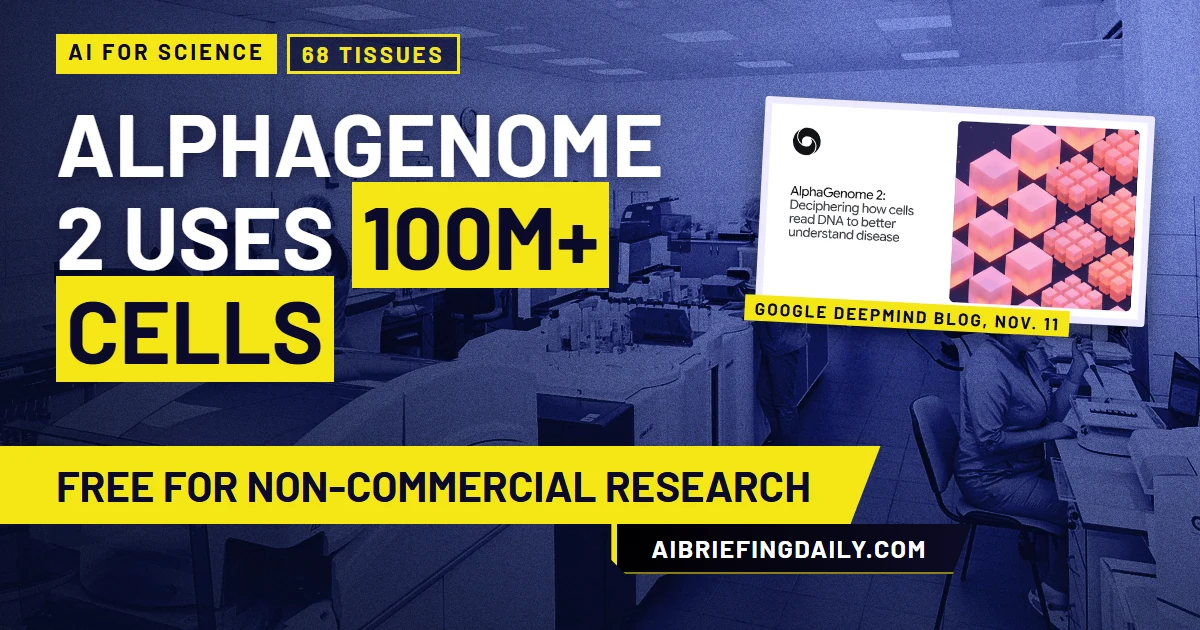
Your heart, your brain and your immune system all read the same DNA. Yet a single-letter change in that DNA can cause trouble in one of them and leave the others alone. How that happens is one of the open questions in human genetics, and on Nov. 11, 2026, Google DeepMind released a tool built to help answer it. AlphaGenome 2 predicts how DNA variants act in specific human cell types (you'll also see it written AlphaGenome2 or AG2).
The new model predicts how DNA sequences and their variations affect specific human cell types, such as a heart muscle cell or an immune cell fighting an infection. DeepMind's announcement says it finds nearly twice as many variants that change gene expression in cells as DeepMind's previous state-of-the-art model, and that it's available today to researchers for non-commercial work.
From tissue averages to single cells
Cells are the building blocks of the body, and every one of them carries the same DNA blueprint. What differs is which genes each cell type switches on or off. Projects like the Human Cell Atlas are mapping that activity for millions of cells, but predicting how a small DNA change shifts it in a given cell is still unsolved, according to DeepMind.
The first AlphaGenome, introduced June 25, 2025 and published in Nature in January 2026, read up to a million DNA letters and predicted properties across thousands of experiments from many tissues at once. In that announcement, DeepMind named cell- and tissue-specific patterns as a priority for future work. AlphaGenome 2 is that next step. On Sept. 8, DeepMind had also released AlphaGenome Atlas, a precomputed map covering all 9 billion possible single-letter changes in the human genome.
The thread DeepMind posted on X on Nov. 11 uses a plain comparison. Looking at a whole tissue at once, it says, is like looking at a blurry image: you see the picture but miss what's happening inside individual pixels. The posts then list the headline numbers (100 million-plus cell profiles, 68 tissues) and note that researchers can plug in data from just a few dozen cells.
Google DeepMind's Nov. 11 thread announcing AlphaGenome 2 (@GoogleDeepMind)
One condition at a time
The key design change is that AlphaGenome 2 is a conditional model. Where the original produced a fixed set of parallel outputs for many tissues and cell lines, the new one takes a target biological condition (a tissue, a cell type or a cell state) as input alongside the million-letter DNA sequence, and predicts for that condition. DeepMind says the earlier parallel approach spread the model's capacity thin and made closely related cell types hard to tell apart.
| AlphaGenome (2025) | AlphaGenome 2 (2026) | |
|---|---|---|
| How it predicts | Many tissues and cell lines in parallel | One condition at a time, set by the user |
| Finest unit | Broad tissues and cell lines | Specific cell types and cell states |
| Training data | Public bulk-tissue consortia (ENCODE, GTEx, 4D Nucleome, FANTOM5) | Bulk and single-cell data, human and mouse, 107 million+ cell profiles |
| New readout | n/a | DNA methylation, added to expression, histone marks and chromatin accessibility |
| Your own data | Fine-tune the model | Feed in a few dozen cells; no retraining needed |
Because the model keeps a cell's state separate from its outputs, it can also fill in what wasn't measured. If a lab supplies only single-cell gene activity, DeepMind says, the model can predict a property like chromatin accessibility, which can help researchers decide which experiments to run next.
What the numbers say
The benchmark DeepMind highlights is TenK10K, a large single-cell map of 28 primary immune cell types. There, AlphaGenome 2 reliably identified 30% of causal variants against 16% for the original AlphaGenome fine-tuned on single-cell data and other specialized tools. For directional gene effects (whether a variant turns a gene up or down), it's 43% against 23%.
Our calculation: that's about 1.9 times as many in both cases (30 ÷ 16 = 1.88, 43 ÷ 23 = 1.87), which matches DeepMind's "nearly twice." It's a company-reported result on one dataset, so independent studies will show how far it travels.
The model also tracked continuous change better on genome regions it hadn't been trained on. DeepMind's example is blood stem cells maturing into red blood cells and immune cells, where the predicted gene activity sits closer to what labs observe than the older model's.
Three real cases from the announcement
Numbers only go so far, so DeepMind tested the model against findings scientists had already made.
A gut inflammation switch. A landmark study had shown that a variant in a distant regulatory switch drives inflammatory bowel disease by overactivating the ETS2 gene in gut immune cells called macrophages. That work, from the Francis Crick Institute with UCL and Imperial College London, was published in Nature in 2024, and it found the enhancer was active only in macrophages. Given only computational predictions across gut immune cell types, AlphaGenome 2 picked out the causal variant and showed it boosting ETS2 in gut macrophages while leaving other cell types and genes largely unaffected.
A vaccine response. Using unseen single-cell data from a COVID-19 mRNA vaccine study, the model told vaccine-activated T cells apart from resting ones. It also found that a variant linked to severe COVID-19 disrupts gene activity more strongly in the activated state, an effect that would be missed in resting cells.
Brain cells and common diseases. DeepMind precomputed predictions for trait-associated variants across hundreds of cell and tissue conditions. That extends enhancer-to-gene mapping to primary human cell types such as astrocytes, the brain cells that support and protect neurons. Across complex traits ranging from height to type 2 diabetes, the scores help narrow down which variants, and which cells, are most likely involved.
Who is likely to use it first
> What makes AlphaGenome 2 exciting is how it adapts directly to new single-cell data without retraining, predicting how DNA variants act in newly profiled cell states from even a small sample of cells. > > Professor Sarah Teichmann, co-founder of the Human Cell Atlas consortium, University of Cambridge
Drug discovery is the other obvious audience. Peter Donnelly, CEO of Genomics Limited, said human genetics is one of the most powerful tools in drug discovery and that sequence-prediction models help bridge the gap between an association signal and what a drug program needs. His company plans to incorporate AlphaGenome 2 into its Mystra platform.
For anyone searching for how this affects patients, the answer today is: indirectly. The model is a research instrument. Its predictions help scientists decide where to look, which variants to test in the lab and which cell types to study. DeepMind states plainly that AlphaGenome and AlphaGenome 2 are for research use only and haven't been validated or approved for clinical or diagnostic purposes.
Quick answers
Can I use it? If you're a researcher, yes. AlphaGenome 2 and interactive Colab tutorials for expression conditioning are available through the AlphaGenome API for non-commercial research. Commercial research is in private preview.
Can it tell me my own disease risk? No. It's built to interpret individual variants in research settings, not to diagnose or predict an individual's health.
Does it need to be retrained on my cell data? DeepMind says no. A snapshot of gene activity from a few dozen cells is compressed into a cell-state representation that conditions the model.
Unconfirmed: Whether AlphaGenome 2's model weights will be downloadable the way the first AlphaGenome's were. The announcement only mentions API access.
Nov. 30, and what comes after
DeepMind is asking researchers to share use cases through a form by Nov. 30, and says selected projects may be eligible for additional quota and credits. It also plans to release AlphaGenome 2 Skills in Google Antigravity, its agentic development platform, and expects pairing specialized models like this one with Gemini 4 in Antigravity (we covered Gemini 4 Carbon's launch on Nov. 10) to speed up research.
The longer-term work is data. With collaborators including the Wellcome Sanger Institute, DeepMind says it's profiling a wider range of human cell types, developmental lineages and perturbed cell states. Each new cell type added to the atlases is one more place where a model like this can look. For readers who follow genetics, that's the number to watch over the next year, ahead of any single benchmark score.
Source: Google DeepMind
Latest
- 01Anthropic's IPO debut rests on Google and Broadcom backstopsBusiness · 2026-11-15
- 02AMD's Lisa Su is named CEO of the Year as Nvidia's CEO walks outBusiness · 2026-11-13
- 03Jensen Huang resigns as Nvidia CEO, Colette Kress named interimBusiness · 2026-11-13
- 04ChatGPT Finances comes to the desktop app for users in the USProducts · 2026-11-12
- 05Nvidia board prepares to oust CEO Jensen Huang, WSJ reportsBusiness · 2026-11-12