Gemini 4 Carbon Is Available: Price, Access, Benchmarks
Gemini 4 Carbon opened Nov. 10, 2026 at $2/$10 per million tokens until Nov. 30. Who gets it, what the benchmarks say and what a task costs.
Key points
- Google opened Gemini 4 Carbon on Nov. 10, 2026, two weeks after limiting it to cyber defenders in the Fairwind Program
- The API (AI Studio, Gemini for business) is open to paying developers at $2 per million input tokens and $10 per million output tokens, the same as Gemini 4 Argon, until Nov. 30; after that, $4 and $20
- In the Gemini app, AI Mode in Search and Google Antigravity, Carbon is rolling out to Google AI Ultra subscribers
- Google says Carbon ranks #1 on CursorBench 4.0, Perplexity's WANDR and Zapier's AutomationBench at more than 2x lower cost per task than the next best external model
- Artificial Analysis measured $7.76 per Intelligence Index task at standard pricing, about 23% less than Claude Opus 5.5, with a hallucination rate of 11% against Argon's 4%
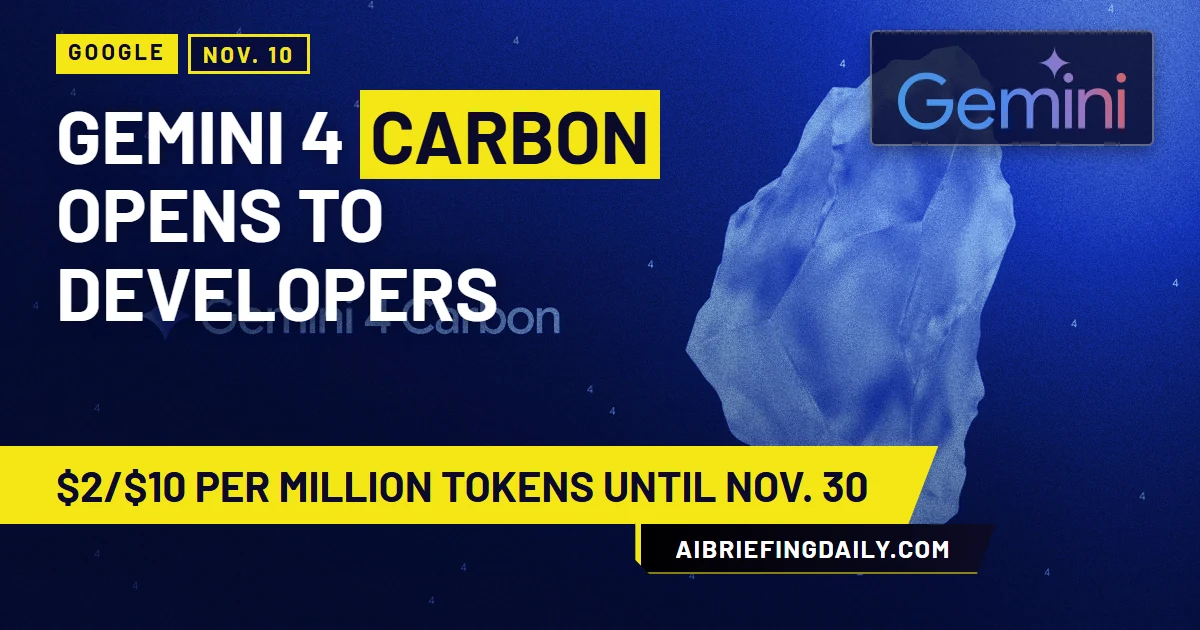
Gemini 4 Carbon is available as of Nov. 10, 2026 to developers, enterprises, scientists and consumers, Google announced, two weeks after it first handed the model to a small group of cybersecurity defenders. The announcement, written by Koray Kavukcuoglu, Google DeepMind's SVP and Chief AI Architect, calls Carbon "our strongest model" and says it posts frontier results in cybersecurity and in long-horizon agentic work across knowledge work, software engineering and scientific reasoning.
The short version for anyone deciding what to do with it: the API is open to paying developers today at an introductory price that doubles after Nov. 30, while the Gemini app, AI Mode in Search and Antigravity are limited to Google AI Ultra subscribers. Here's how the launch breaks down, and what outside testers have measured so far.
Google AI's post on X, Nov. 10, 2026, announcing that Gemini 4 Carbon is now available (@GoogleAI)
Carbon and Argon are meant for different jobs
Google didn't replace its Gemini 4 lineup, it split it. The post says Gemini 4 Argon, released on Oct. 13, "remains the ideal choice for the majority of software engineering and knowledge work." Carbon is aimed at "tasks that test the limits of a model's intelligence": multi-step debugging, large migrations, root-cause hunts across subsystems and open-ended research.
The trade is tokens. Google says Carbon uses more of them than Argon "to explore thoroughly, reason deeply, and run extended verification loops." That matters for the bill, because the price per token is identical to Argon's.
The timeline: cyber first, everyone else two weeks later
Google's Oct. 28 announcement said Carbon would start with "a subset of cyber defenders" through the Fairwind Program, with more trusted partners added gradually, while Google gathered feedback and tuned guardrails. It also said Google was taking part in the U.S. government's voluntary pre-release model testing process, a program we covered when the White House kept its testing framework secret in a FOIA suit.
Nov. 10 is the next step. Google's wording is that Carbon now "joins Argon in our family of frontier models across our products," with access depending on who you are:
- Developers: Gemini API paid tier in AI Studio and Android Studio.
- Enterprises: Gemini for business (API or model menu), Antigravity, CodeMender.
- Consumers: Gemini app and AI Mode in Search, for Google AI Ultra subscribers.
- Antigravity users: rolling out to all Google AI Ultra subscribers.
- Scientists: apply for six free months of Antigravity's top usage tier.
- Cyber defenders: apply to the Fairwind Program for "Carbon for cyber".
The difference between the two models is visible in that list: Argon reached Google AI Pro subscribers in the Gemini app and AI Mode at its launch, per Google's Argon post, while Carbon's consumer access is described as an Ultra feature.
What $2 and $10 buys, and when it stops
Carbon launches at the same introductory price as Argon: $2 per million input tokens and $10 per million output tokens. A footnote in Google's post sets the end date: after Nov. 30, 2026, the price becomes $4 and $20.
Our reading: if your usage stays the same, a Carbon bill that looks like $1,000 in November becomes about $2,000 in December. To budget it, take your monthly input and output tokens, multiply by $4 and $20 per million, and compare the result with Argon on the same tasks, since Carbon spends more tokens per task.
Artificial Analysis, which publishes independent model rankings, prices its charts at the standard $4/$20 and notes Google's launch discount. At standard rates it measured $7.76 per task on its Intelligence Index, roughly the same as Argon's $7.68, even though Carbon scores nine points higher. By our math, at the introductory 50% discount the same task would run near $3.88, assuming the token count doesn't change.
The benchmarks Google chose, and what an independent tester added
Google's headline claim is that Carbon "ranks #1 on CursorBench 4.0, Perplexity's WANDR, and Zapier's AutomationBench at more than 2X lower cost per task compared to the next best external model." On the Multimodal Knowledge Agent benchmark, a new test Google built with Artificial Analysis, Carbon ranks #2 at more than 6x lower average cost per task than the top model. Hebbia and Balyasny Asset Management, both financial-research users, report Carbon at or near the top of their own evaluations.
Artificial Analysis's own write-up, published Oct. 28 for the limited release, adds numbers measured the same way for every model:
- Intelligence Index v5: Carbon scored 59 and took the top spot, with the #1 result on four of the index's nine evaluations, including HLE-Diamond and AA-Omniscience.
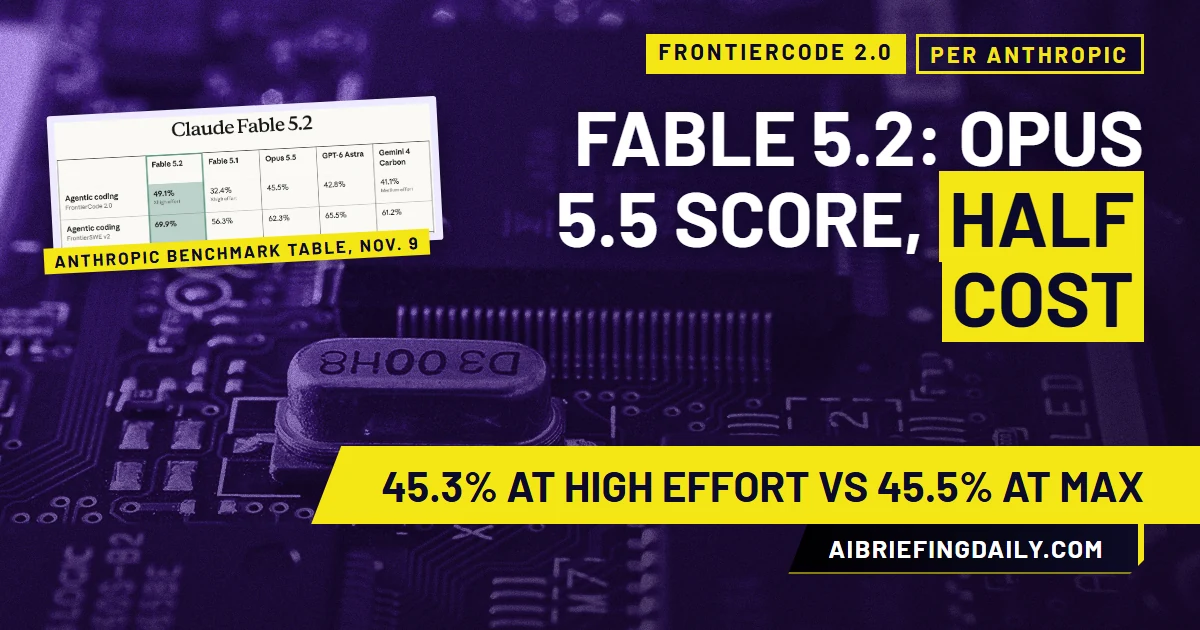
- Coding agents: with Google's Antigravity CLI, Carbon scored 59 on the Coding Agent Index, three points behind Claude Code running Opus 5.5, which scored 62, and second on Terminal-Bench 4.0 at 64%.
- Cost per task: $7.76, about 23% below Claude Opus 5.5's $10.04, using 123,000 output tokens per task against Opus 5.5's 173,000, or 29% fewer.
- Accuracy and hallucination: 54 on AA-Omniscience, six points above Opus 5.5, with a hallucination rate of 11% against Argon's 4%. Both Claude Opus 5.5 and GPT-6 Astra sit at 50% on that metric.
Artificial Analysis's live model page has since updated Carbon to 60 on the index, listing it fourth among 74 models, with a 1-million-token context window and roughly 25.6 minutes per index task, about twice the median. For long agentic jobs that speed is part of the picture: Carbon is built to run for a long time, and it does.
The cyber numbers, and the guardrails Google put around them
This is where Carbon's launch is most specific. Google's October post reported 88.2% on SEC-bench Pro (finding vulnerabilities), 54.8% on ExploitGym (exploiting them) and 71.0% on CWE-bench (patching), all measured without guardrails. The Nov. 10 post adds field results:
- In Project Fortify, Google's scanning, triage and remediation system, Carbon reached 100% recall on scanning and 95% precision on triage on an internal benchmark, with more than 25% relative improvement over Argon's recall on open-source repositories.
- Google's Cloud Vulnerability Research team used Carbon to show that two bugs in a popular open-source project were exploitable, comparable in severity to the recent PHP2Shell exploit; details wait for responsible disclosure.
- Wiz, running Carbon in its Scan for Good program, said the model found zero-day vulnerabilities at two major SaaS providers in under two hours.
"Gemini 4 Carbon for cyber is among the highest-scoring models we have ever tested, and across our evaluations it gets there in half the steps of its predecessor." — David Slater, Founder and Chief Architect, Armadin, quoted in Google's Nov. 10 post
The same capability is why the strongest version stays gated. Google says its safeguards cut the per-attempt breach rate in simulated attacks to 0.8%, from 3.1% on Argon, and that external tester Trajectory Labs found no new universal jailbreaks across 132 hours and more than 13,000 requests. On Gray Swan's indirect prompt-injection benchmark Carbon reached a 0% attack success rate two weeks ago; Google adds that injection robustness "remains an area for continued improvement." On a 375-task agentic honesty benchmark, Carbon passed 92% of tasks, against 70% for Argon. For comparison with a rival's approach, see our look at OpenAI's GPT-6 Cyber and its Firefox and Linux results.
Swarms in Antigravity, and what scientists get
Alongside the model, Google is previewing a /swarm command in Google Antigravity that turns one prompt into a coordinated team of agents you can watch in real time. The suggested split: Carbon for architecture, coordination and auditing, with faster, lighter models working in parallel on isolated workspaces and adversarial verifiers testing each change. Google's demos include a 3D Eiffel Tower construction exhibit and a 906,000-triangle reconstruction of its own Platform 37 office, built from public planning PDFs over ten overnight loops.
For researchers, Google says Carbon increased the number of homologs retrieved for seven low-data protein families from the CASP17 test set by 40 times on average, which could help structure-prediction tools without retraining. It also describes using Carbon inside a new framework, AlphaProof Code, to prove security properties of the code behind the Signal protocol in weeks. Four weeks ago Google opened applications for 10,000 scientists to get six free months of Antigravity; participants and new applicants now get Carbon as well.
A cheap test before you pick a model
Google's tweet frames Carbon as the model "for your hardest tasks," and its own post says Argon remains the default for most work. The practical test is cheap to run: take five or ten tasks your team already fails or abandons, run them on both models, and record cost, time and result. Carbon's per-token price matches Argon's, so a win has to come from finishing work Argon can't, not from saving money.
One detail Google's post doesn't cover is whether Carbon will reach Google AI Pro subscribers, as Argon did at launch. The other date to circle is Nov. 30, when the $2/$10 introductory price ends and the $4/$20 rate takes over, as stated in the footnote of Google's announcement.
Source: Google
Latest
- 01Anthropic's IPO Sells Shares, Not Control: 50.1% Stays PutBusiness · 2026-11-10
- 02Anthropic IPO: $70-$80 Price Range Pulled at RoadshowBusiness · 2026-11-10
- 03Project Zenith on AMD Ryzen AI Halo: Windows 11 Dev PCProducts · 2026-11-10
- 04Nvidia Class Action Over Huang Disclosures: What It SaysBusiness · 2026-11-10
- 05Claude Fable 5.2 in GitHub Copilot: Admin Opt-In, PricingProducts · 2026-11-10